
Beholder, Tepin head 2022 Hall of Fame inductees
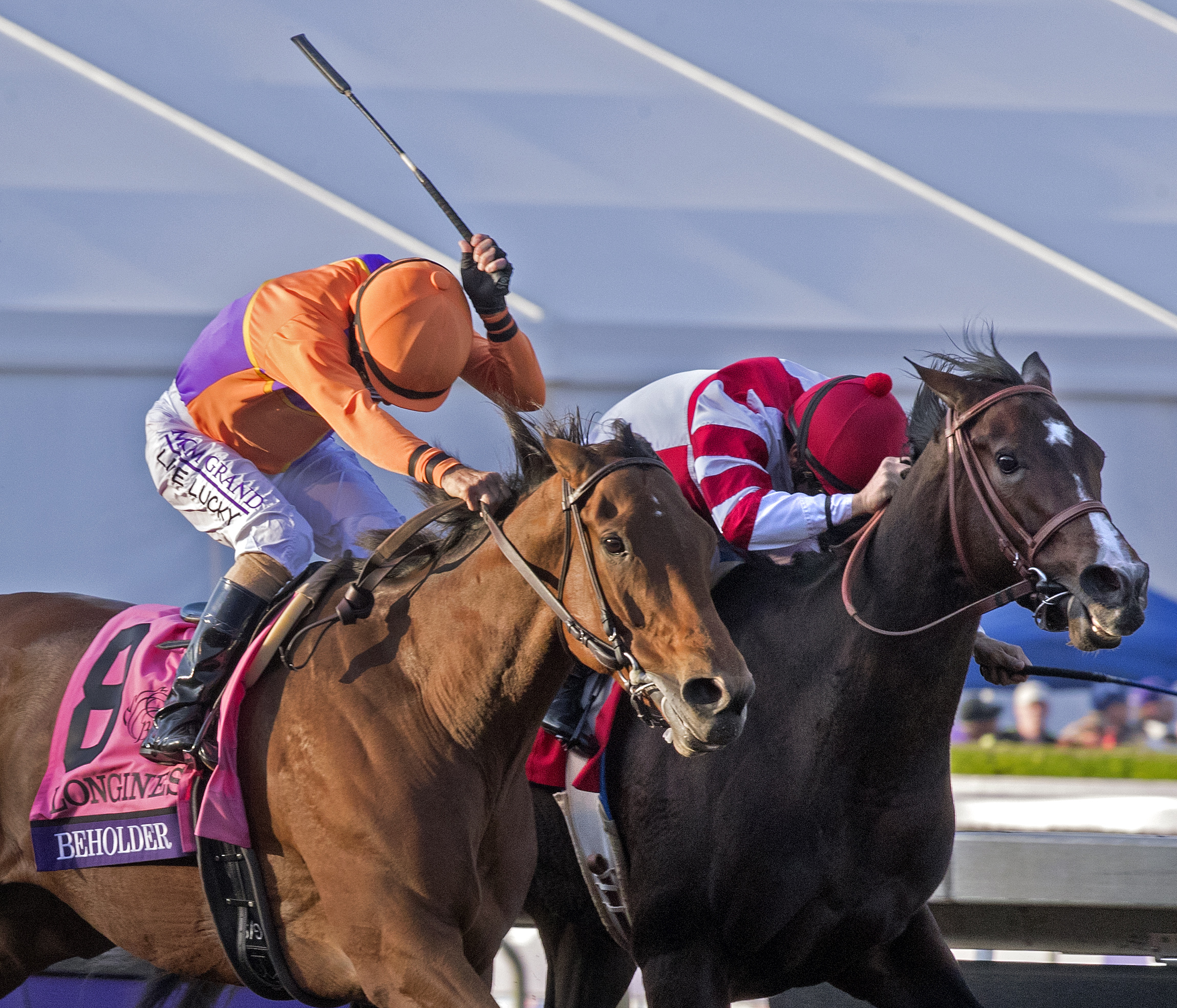
The outstanding mares Beholder and Tepin on Wednesday were announced as the contemporary inductees to the National Museum of Racing and Hall of Fame, both gaining entry in their first year of eligibility.
Joining them in the Class of 2022 will be six others. The racehorses Hillsdale and Royal Heroine along with trainer Oscar White were chosen by the Historic Review Committee, the equivalent of an old-timer’s committee. In addition, James Cox Brady, Marshall Cassidy – grandfather of the racecaller and racing official – and James Ben Ali Haggin were selected as Pillars of the Turf for their contributions to the sport.
Beholder and Tepin were the only two of the 11 finalists on the contemporary ballot to receive at least 50 percent of the vote from the 148 of 161 eligible voters who returned ballots. There is no limit to how many candidates a voter can support. Falling short of the 50 percent mark were the mares Blind Luck, Havre de Grace, and Rags to Riches, the brilliant sprinter Kona Gold, trainers Christophe Clement, Graham Motion, Doug O’Neill, and John Shirreffs, and jockey Corey Nakatani.
The Hall of Fame does not release vote totals, so it’s not known how close any of the other nine came to getting in, nor whether a slam-dunk candidate like Beholder received 100 percent support.
Those selected by the Historic Review Committee and as Pillars of the Turf needed to receive support from at least 75 percent of those respective panels. Those choices are not made by the larger group that receives the contemporary ballot.
All eight will be inducted Aug. 5 at the Fasig-Tipton sales pavilion in Saratoga Springs, N.Y., just around the corner from where the Hall of Fame is located.
Beholder had one of the great careers of the current era, winning four Eclipse Awards and three Breeders’ Cup races while capturing at least one Grade 1 race at ages 2, 3, 4, 5, and 6, something that had not been done in 40 years.
Beholder, a daughter of Henny Hughes out of Leslie’s Lady, by Tricky Creek, was purchased as a yearling by the Spendthrift Farm of then-owner B. Wayne Hughes and was trained by Hall of Famer Richard Mandella. She won 18 of 26 starts, 13 graded stakes, 11 Grade 1, including the 2015 Pacific Classic against males and a stirring career finale against Songbird in the 2016 Breeders’ Cup Distaff. That Distaff victory made Beholder only the second horse, after Hall of Famer Goldikova, to win three Breeders’ Cup races. Now age 12, Beholder is a broodmare at Spendthrift.
Tepin also was a multiple Eclipse Award winner, nailing down the female turf title in 2015 – when she won the Breeders’ Cup Mile – and 2016, during a campaign that included a victory in the Queen Anne Stakes at Royal Ascot. Those were two of her three Grade 1 victories against males, the other being the Woodbine Mile.
Tepin, by Bernstein out of Life Happened, by Stravinsky, won 13 of 23 starts in four seasons on the racetrack. Hall of Famer Mark Casse trained her for owner Robert Masterson. Tepin, now age 11, also is a broodmare, at Coolmore in Ireland.
:: For the first time ever, our premium past performances are free! Get free Formulator now!
Hillsdale won 23 of 41 starts racing in the late 1950s. He swept what became known as the Strub Series, capturing the Malibu, San Fernando, and the Santa Anita Maturity, which later was renamed the Strub. The Malibu was one of five stakes he won at age 3. At age 4, he won 10 stakes in 13 starts, including the Californian, Hollywood Gold Cup, and Aqueduct Handicap. Hillsdale – by Take Away out of Johann, by Johnstown – originally was trained by Odie Clelland, then was trained by Martin Fallon Jr. after a private sale to owner Clarence Smith. According to the Hall of Fame, he is the first horse bred in Indiana to be enshrined.
Royal Heroine beat the boys in the inaugural Breeders’ Cup Mile, part of a 1984 campaign that brought her an Eclipse Award as champion female turf horse. That year she also won the Matriarch and was second to John Henry, the 1984 Horse of the Year, in the Arlington Million.
Royal Heroine, by Lypheor out of the Relko mare My Sierra Leone, was owned by Robert Sangster. She was trained initially in Europe by Michael Stoute, for whom she won the Prix de l’Opera, then blossomed in the United States under a young trainer named John Gosden, for whom she won a division of the Hollywood Derby at the end of 1983 as a preview of coming attractions in 1984. Royal Heroine won 10 of 21 starts. She died in 2002 at age 22.
White, who trained from 1940 through 1978, exclusively for the Jeffords family, is best known for training Pavot and One Count, both of whom won the Belmont Stakes and Jockey Club Gold Cup. Pavot was the 2-year-old champion of 1944. One Count was Horse of the Year in 1952. White also trained Kiss Me Kate, the champion 3-year-old filly of 1951.
White won the Travers, Alabama, and Delaware Oaks three times each, and twice won races like the Delaware Handicap, Gazelle, Jockey Club Gold Cup, Saratoga Cup, and Saratoga Special. His other major victories included the Acorn, Futurity, Hopeful, Jerome, Manhattan, Maskette, and Whitney. He died in 1983 at age 74.
Brady was one of the most-influential people in New York racing, including serving as chairman of the New York Racing Association during the reconstruction of Belmont Park and upgrading of Saratoga in the 1960s. Brady also had significant positions with The Jockey Club, Thoroughbred Racing Association, National Museum of Racing and Hall of Fame, and Monmouth Park.
As an owner and breeder, Brady won such prestigious races as the Acorn, Alabama, Coaching Club American Oaks, Hopeful, and Met Mile, as well as the Epsom Oaks. He served in the Navy in World War II, earning a Bronze Star for service in the South Pacific. Brady died in 1971 at age 63.
Cassidy, son of famed New York starter Mars Cassidy, helped develop the modern starting gate – which replaced the old, chaotic method of a walk-up start in which horses were dispatched when a tape went up – and improved the technology behind the photo-finish camera, the electronic timing of races, and patrol films.
Cassidy also introduced prerace veterinary exams and saliva testing. He was director of racing for NYRA the final years of his life and also was executive secretary of The Jockey Club, for whom he started a school for race officials and helped found the Round Table Conference, held to this day each August in Saratoga. He died in 1968 at age 76.
Haggin was a titan of the sport in the second half of the 19th century. After making his fortune in silver and copper mining, he began breeding horses near Sacramento, Calif., and eventually purchased Elmendorf Farm in Kentucky, part of an operation that encompassed 8,700 acres in Central Kentucky.
Haggin’s best runners included Hall of Famers Firenze, who won 47 of 82 starts and is considered a four-time champion from 1887-90, and Salvator, who won 16 of 19 starts and is considered the champion 3-year-old male of 1889 and a two-time Horse of the Year in 1889-90. Haggin won the 1886 Kentucky Derby with Ben Ali, the 1885 Belmont with Tyrant, and the 1903 Travers with the filly Ada Nay. He bred two other Belmont winners. He died in 1914 at age 91.