

Baffert attorneys call first witnesses at suspension appeal hearing
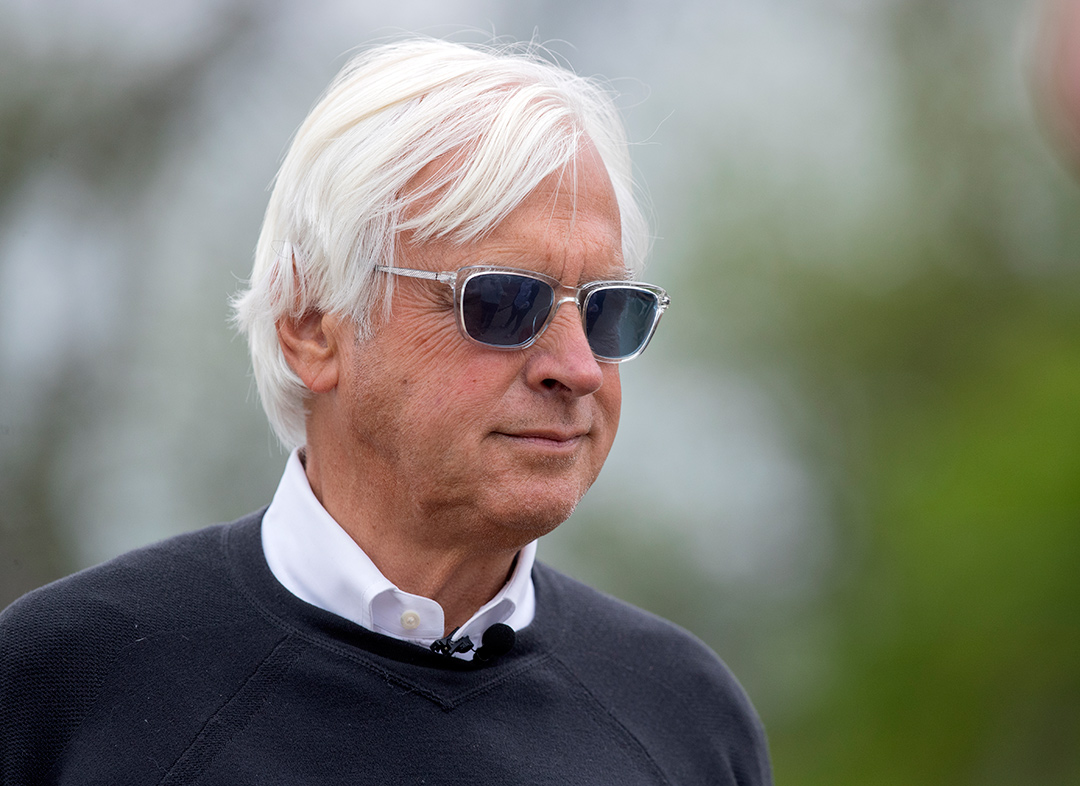
FRANKFORT, Ky. – Attorneys for Bob Baffert on Monday began their case in a hearing to contest the trainer’s already-served 90-day suspension by pressing ahead on a contention that Kentucky’s rules do not apply to a treatment Baffert has acknowledged his staff repeatedly applied to the horse Medina Spirit in the lead-up to last year’s Kentucky Derby.
The attorneys called three witnesses to the stand to lend support to the claim that a finding of the regulated corticosteroid betamethasone in the post-Derby urine sample of Baffert’s Medina Spirit should have been treated as a non-violation, given testing that they say confirmed that the drug came from a benign skin ointment, and not an injection of the corticosteroid.
Baffert was issued a 90-day suspension by Kentucky’s stewards in February, through an order that also disqualified Medina Spirit from the 2021 Derby. Baffert served the appeal from early April to early July after his attorneys exhausted efforts to have the suspension stayed until his appeal had been heard and adjudicated. His attorneys are seeking to get the suspension erased from his record and the disqualification reversed.
The appeals hearing is being conducted in a room in an office building in Frankfort, Ky. Attorneys for the Kentucky Horse Racing Commission, who are representing the state stewards, presented their case over 3 1/2 days last week.
:: DRF Bets members get FREE DRF Past Performances - Formulator or Classic. Join now!
The first Monday witness, Dr. George Maylin, who heads up an equine drug-testing laboratory in New York, said that he conducted testing on a portion of Medina Spirit’s urine sample and found the ingredients in the ointment, called Otomax, including betamethasone valerate. Maylin testified that he believed that his testing supported Baffert’s contention that Medina Spirit was administered the ointment.
A second witness called to the stand, Dr. Steven Barker, the former head of the equine drug-testing laboratory at Louisiana State University who retired in 2016, said that he supported Maylin’s conclusions under questioning from one of Baffert’s attorneys, Craig Robertson. Baffert’s legal team had previously established during the hearing that Otomax had been prescribed by one of Baffert’s veterinarians, and that Baffert knew the ointment was being administered daily, though Baffert has said he was unaware it contained betamethasone.
“The preponderance of evidence clearly shows that this was, as prescribed by the veterinary, that this was a topical administration of Otomax,” Barker said. Later, Barker told one of Baffert’s attorneys that he did not believe the ointment should be regulated in the same way as the injection.
Dr. Barker also testified that he believed the concentrations of betamethasone found in the samples would not have a pharmacological effect on a horse if applied topically, citing a recent dissertational study of cortisol suppression on horses who received a topical application of a solution containing the drug compared to horses administered an intravenous solution of the drug.
Jennifer Wolsing, the general counsel for the KHRC, used her cross examination of Maylin to cast doubt on whether Maylin’s testing conformed to strict guidelines on scientific methodology and validation. She also pointed to several clerical errors in his reports on the analysis of the sample to suggest that the results were not fully trustworthy.
But the KHRC legal team has also been arguing that Maylin’s analysis does not prove that betamethasone was not also administered to Medina Spirit in another form. Betamethasone in horse racing is most commonly injected into joints to treat inflammation, and most regulators recommend that the drug be injected outside of two weeks of a race to avoid a post-race positive.
During the cross of Maylin, Wolsing began questioning him about his efforts to detect certain variants of betamethasone in the analysis of Medina Spirit’s sample, and in response to one question that was somewhat tangential to the issue, Maylin said that he did not “rigorously” look for betamethasone acetate or another form of the drug.
“You didn’t rigorously look for betamethasone acetate or betamethasone phosphate, is that your testimony?” she asked, in an attempt to get Maylin to restate the claim.
Wolsing also pursued this line of questioning on cross examination with Barker, asking him if he was “surprised” that Maylin claimed he could not find betamethasone acetate in the Medina Spirit sample he tested for the Otomax ingredients given that the sample was not treated with a chemical preservative used to preserve that type of molecule in biological samples.
:: Get Daily Racing Form Past Performances – the exclusive home of Beyer Speed Figures
“I wasn’t surprised,” Barker said.
Wolsing also got Barker to acknowledge that the concentration found in Medina Spirit’s sample was consistent with some concentrations found in a study of horses three days after betamethasone was injected into their joints.
A third witness called by Baffert’s team was Thomas Lomangino, the former head of an equine drug-testing laboratory in Maryland who retired in 2016. Under questioning from Clark Brewster, an attorney who is representing Medina Spirit’s owner, Amr Zedan, Lomangino suggested that the initial lab reports finding betamethasone in the Derby samples showed evidence of contamination or violations of standard operating procedures.
Wolsing also spent part of her cross examinations attempting to suggest that the witnesses called by Baffert’s team were influenced by their regular appearances in cases involving Baffert and other trainers. The witnesses acknowledged that they received payments for their testimony.
Following the conclusion of the hearing, the hearing officer in the case, Clay Patrick, a Frankfort attorney, will have several months to issue a report that will contain recommendations for the KHRC on whether to accept, modify, or reject the stewards’ decision.
The hearing is scheduled to resume on Tuesday, when Baffert’s attorneys are expected to close their case.