

Andrew Beyer: Kaleem Shah living the American dream
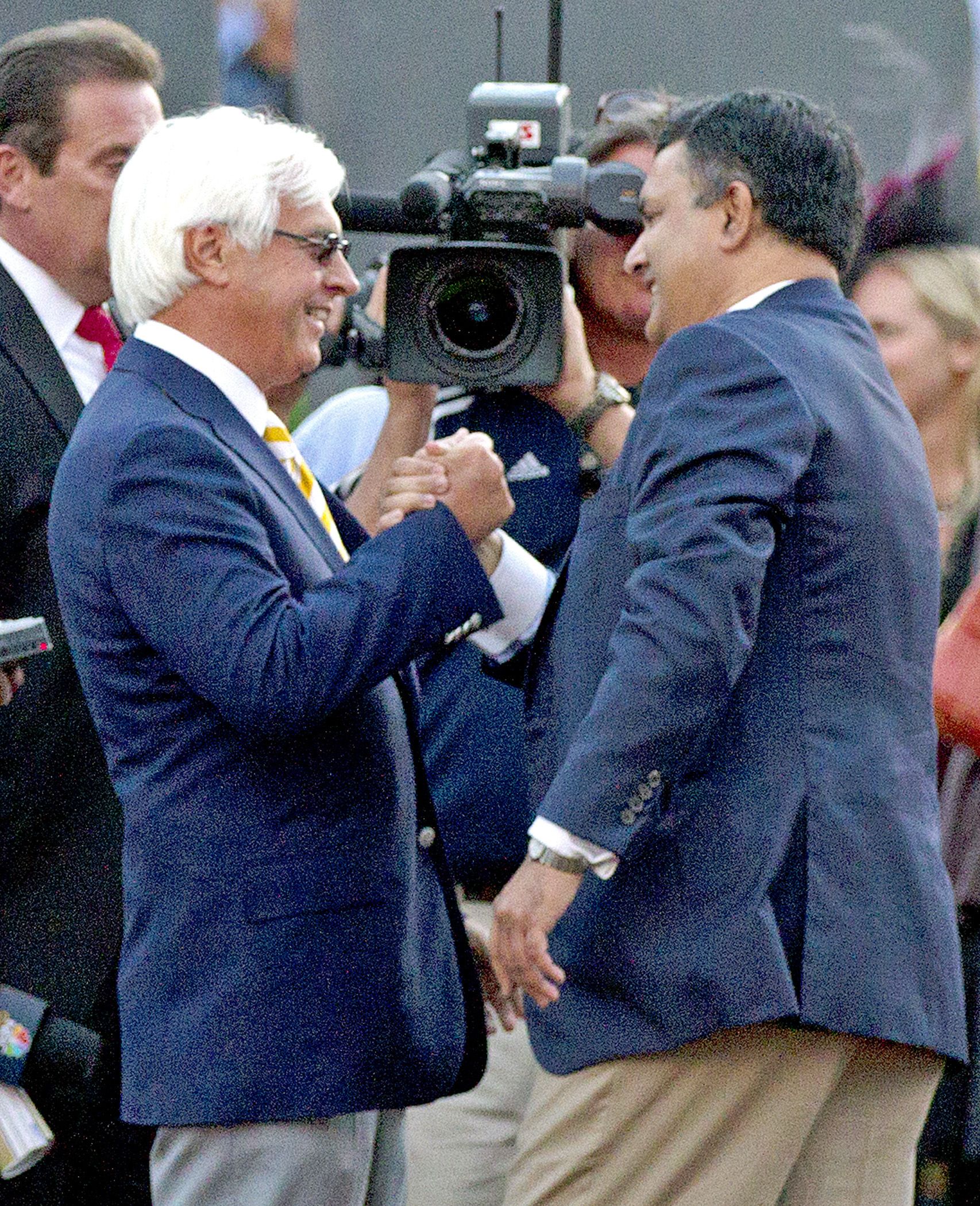
An immigrant from India to the U.S., Kaleem Shah embraced the opportunities in his new country, gave up his old citizenship to become a nationalized American, and – when he had the resources to operate a racing stable – chose red, white, and blue silks for his horses to carry. Now he has a chance to make his mark on one of the most distinctive American institutions. He could win the Kentucky Derby on Saturday.
Shah, who lives in Vienna, Va., and operates a business based in Reston, runs his horses mostly in California, where his colt Dortmund dominated the $1 million Santa Anita Derby earlier this month. Undefeated in six career starts, he is likely to be one of the top two betting choices at Churchill Downs, along with his stablemate American Pharoah, who is also trained by three-time Derby winner Bob Baffert.
Dortmund’s emergence as a star this winter continued an exceptional string of high-profile victories for Shah, whose Bayern captured America’s richest race, the Breeders’ Cup Classic, in the fall. Although Shah is only now getting recognition as an important figure in the sport, his connections with racing go back to his early childhood.
Shah grew up in southern India, where his father, Majeed, was one of the country’s leading Thoroughbred trainers, twice the winner of his country’s Triple Crown. “For as long as I can remember, I went to the track with him,” said Shah, who loved the animals as well as the glamour of the sport. But Majeed made it clear that he did not want his son follow in his footsteps.
He insisted that Kaleem’s top priority was to get an education. At some time in the future, the father told him, “You could come into the game as an owner.” Kaleem assented: “I admired, respected, and loved him. He saw potential in me, and I knew he had advised me to do the right thing.”
Shah went to college in India, came to the U.S., and earned master’s degrees at Clemson and George Washington University, one in computer programming and the other in international finance. He worked as a software engineer before starting his own company, Calnet, in 1989, with less than $3,000 in capital, a personal computer, and a dot-matrix printer. Originally an Internet-technology company for private clients, Calnet grew to become a significant government contractor. It obtained a top-secret security clearance and won contracts for intelligence analysis and language services. (Among them: $66 million from the U.S. Army to manage translation and interpretation services at Guantanamo Bay.)
As his business began to prosper, Shah bought some horses of moderate class in the mid-1990s and campaigned them at the Maryland tracks under the care of trainers James Murphy and Dale Capuano. He got serious about the game in 2009, with Baffert as his trainer and Donato Lanni of Lexington, Ky., as a bloodstock adviser. Shah liked their approach as they evaluated horses he might buy at auction; they placed a strong emphasis on athleticism over pedigree.
But even with such expert guidance, Shah’s luck was initially bad. One of his first big ventures was his $1.9 million purchase of a 2-year-old named Take Control, who was hampered by shin problems, raced only four times through age 6, and then was euthanized after being injured in a workout. Shah experienced ill fortune with some of his other early acquisitions, too, yet he remained optimistic.
“If you’re in horse racing like I have been all my life, you know that there will be just a few horses who pan out, and that handful can pay for all the investments,” he said. “It’s like the dot-com era – only a few companies are going to be super-good.”
His patience was finally rewarded when the late-blooming Bayern emerged as a star 3-year-old and won the Breeders’ Cup Classic. Some racing fans would say that Shah was the beneficiary of undeserved good fortune; Bayern instigated a chain-reaction bumping incident as he left the gate, and the stewards conducted an inquiry before deciding not to disqualify him. After the stewards left his number up, Bayern became the top money-winning U.S. racehorse of 2014, with earnings of $4.38 million, and Shah was the No. 2 money-winning owner.
Shah had another important moment last year when he paid $140,000 for a son of Kentucky Derby winner Big Brown at an auction of 2-year-olds in Maryland. The colt, whom he named Dortmund (after the famous German soccer team) was a giant of a horse, and such animals are sometimes ponderous and slow to develop. Dortmund, however, was light on his feet and athletic from the start. He won all three of his races as a 2-year-old, but it was his victory in the Robert B. Lewis Stakes at Santa Anita in February that made his reputation.
After chasing a front-runner and taking the lead, Dortmund was challenged on the turn by Firing Line, his main rival. Firing Line pulled ahead of him by nearly a length, and announcer Trevor Denman exclaimed, “Firing Line has [Dortmund’s] measure!”
Baffert later admitted that he was thinking at that moment, “Boy, I was wrong about this horse.” But Dortmund refused to surrender. He cut into Firing Line’s lead inch by inch and won a photo finish by a head.
When buyers spend big money for well-bred, good-looking horses, they can never know what’s inside the horse and whether he’ll be a tough competitor. When Dortmund beat Firing Line, the owner said, “That’s when we knew.” Shah’s colt has every ingredient necessary for success in the Derby – experience, speed, and guts. A classic American success story might be about to get even better.
Copyright 2015 The Washington Post