

American Pharoah has Zayat back on top
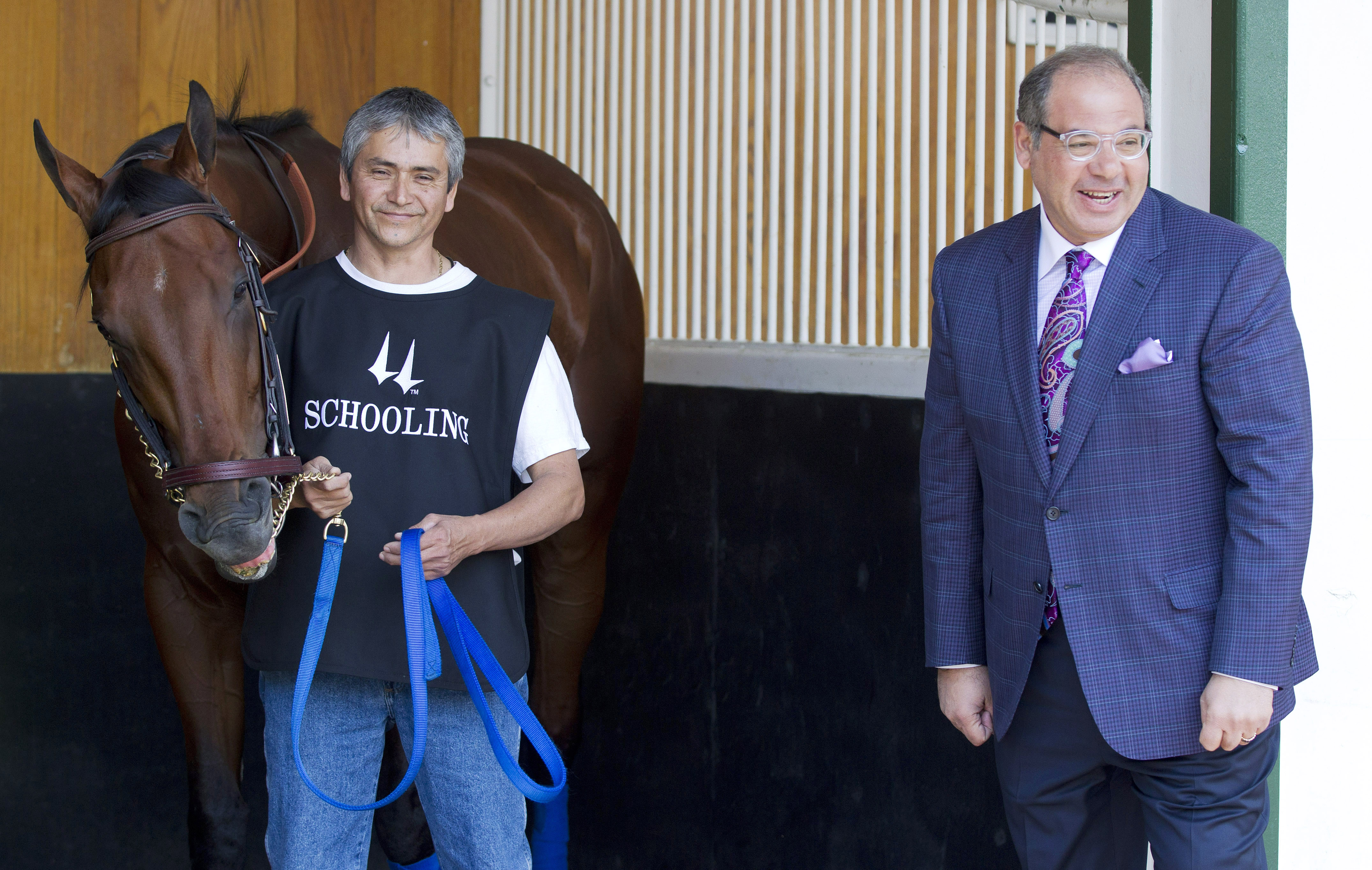
LEXINGTON, Ky. – Five years ago, it was not certain if Ahmed Zayat had a future in horse racing.
After having spent tens of millions of dollars since 2005 on horses and quickly rising to the highest echelon in the sport, Zayat in early 2010 was embroiled in a lawsuit with his bank over his line of credit. His coast-to-coast racing stable had filed for bankruptcy. His highly regarded colt Eskendereya was withdrawn from the 2010 Kentucky Derby just days prior to the race with an injury.
Meanwhile, racing regulators across the country were examining his ties to a pair of brothers who had been convicted of running an illegal gambling operation – a relationship that only became apparent because of debts listed in his stable’s bankruptcy filing.
“I will be honest, from a financial standpoint, it was the hardest point in my life,” said Zayat, who sold his Egyptian beverage company, Al Ahram, in 2002 to Heineken for $280 million. “For my entire life, I thought that I needed to have a good name. It’s what my father always told me. You have to have a golden reputation.”
Now, five years removed from what appeared on the outside to be one of the most ignominious and rapid falls from grace in modern American racing history, Zayat is back on top.
Zayat’s homebred American Pharoah, a son of his horse Pioneerof the Nile and out of his mare Littleprincessemma, likely will go off as the favorite in Saturday’s Kentucky Derby. Zayat also will start two other Derby colts, El Kabeir and Mr. Z. His racing stable, Zayat said, has emerged fully from the bankruptcy filing, and his relationship with the bank that filed a lawsuit against him is “super,” with a new line of credit extended through 2018.
And, to repeat, there’s that horse, American Pharoah, who comes into the Derby with four dominating wins in five starts and is being talked about breathlessly in some circles as a potential Triple Crown candidate.
“The way he moves, I’ve never seen anything like it,” Zayat said. “To have an animal that is doing something so admirable, who is so pleasing to the eye ... I’m so excited I can’t sleep.”
Brash, outspoken, and passionate – perhaps to a fault – about horses, horse racing, and gambling, Zayat has always said that doubts over his ability to recover from his financial difficulties were misplaced. His record over the past five years lends credence to that assertion. Since 2009, he has finished second in the Kentucky Derby three times, and along the way, a handful of his colts have performed so well on the track that they have entered the breeding shed with lofty expectations and high stud fees.
If this was the picture of a man in trouble, many would love to have such trying times.
In a lengthy interview this week that did not start out on the best of terms, Zayat initially said he would not answer questions surrounding the bankruptcy filing of his stable and the dispute with his bank, Fifth Third, which alleged late in 2009 that he was in default on $34 million in loans. But over time, he softened his stance to acknowledge that the experience had not only dealt a heavy blow to his ego but also had resulted in a re-evaluation of how he spent his money and ran his operation.
“The first year was very tough,” Zayat said in reference to the settlement he reached with Fifth Third in late spring of 2010 that required him to pay down his line of credit from a portion of his horse sales and earnings from his stable. “We had to get lean and mean. We had to think of it more in the terms of dollars and cents. We had to restrain my passion. Honestly, in the early days, if I liked something, I bought it. I didn’t care about the price. I was bidding against sheikhs. I had to realize that everything has a price, a commercial price.”
While not anywhere near the realm of “lean,” Zayat Stables is certainly much smaller than it used to be. At its peak in 2009, Zayat said, the stable, which is a private corporation, had 250 horses spread out at tracks from California to New York and filling stalls at central Kentucky farms. Now, the stable numbers about 140 horses, including weanlings, yearlings, horses in training, broodmares, and shares of stallions, Zayat said.
Characteristically, Zayat jumped into racing with both feet. A lifelong admirer of horses, Zayat bought his first Thoroughbreds at auction in 2005, using a variety of advisers. By the end of 2008, he had spent at least $62.5 million at auction on 252 horses, according to auction records, and had amassed enough stock to catapult his racing operation to owners’ titles at Del Mar and Saratoga, where he set a record in 2007 for the most wins at the meet. In 2008, his stable led the country in purse earnings.
Then the recession hit. By the time of the 2009 Derby, in which Zayat’s Pioneerof the Nile finished second, Lehman Brothers had gone spectacularly bankrupt, the federal government was handing out bailouts, and banks were putting strangleholds on credit. While Zayat would not comment specifically about the fallout on his operation, his auction spending slowed considerably. In 2009 and 2010, he laid out a total of approximately $6.4 million on auction horses, well below his average annual spending of $15.6 million during the preceding four years.
Fifth Third filed the lawsuit against Zayat at the end of 2009. Zayat countersued early in 2010, claiming the bank had reneged on provisions of his credit agreement. Then, on the advice of his attorneys, Zayat elected to place his racing stable in bankruptcy as a defensive maneuver, he said.
“My intent was not to get a haircut,” Zayat said. “That is not my way. I wasn’t looking to pay 70 cents or 80 cents on the dollar of my debt. It’s like my attorneys told me, ‘It’s not personal, it’s business.’ In fact, I paid everyone at 100 cents on the dollar. All the payments were made. We satisfied all our obligations in full. No one got paid less than what they were owed. And right now, we are healthy financially as a company, we have total freedom to do what we want, and my relationship with Fifth Third is super.”
There were hiccups along the way. Zayat’s bankruptcy filing listed outstanding loans of $600,000 to a pair of New Jersey brothers, Jeffrey and Michael Jelinsky, who had pleaded guilty in 2009 to running an illegal gambling operation out of Las Vegas. Zayat, a resident of New Jersey since moving to the United States, said he knew the brothers personally, but he maintained that he had no idea they were involved in bookmaking when he provided the loans over a three-year period from 2006-08. Several racing commissions investigated the ties, and they ultimately cleared Zayat to race.
Then, in 2013, Zayat was investigated by the New Jersey Racing Commission based on an allegation that the New Jersey Sports and Exposition Authority had extended him credit to wager through the authority’s account-wagering operation, a violation of state law. The allegation was made in a lawsuit filed by the owners of Freehold Raceway against the NJSEA.
Though officials of the New Jersey Racing Commission said the investigation remains open – while declining to provide details – Zayat said he has not talked with investigators about the allegation for two years. Freely acknowledging that he often bets tens of thousands of dollars over a weekend, he said the allegation was based on a misunderstanding over how he wired money into his account, and he said the investigation no longer involves him.
While Zayat remained defensive about his financial problems and his ties to the two gambling episodes throughout the interview, he said he wanted the focus on Derby week to fall on his horses and the impact they have had on his life and family. Many of his horses are named with family members in mind, and this week he said that everything he has done in the past 10 years in horse racing has finally fallen into place, ticking off the horses in his operation who led to the foaling of American Pharoah.
“He’s the Zayat blood from A to Z, literally,” Zayat said. “It’s just a tremendous amount of satisfaction for me and my whole family. This is why I’ve done what I’ve done. This horse, it’s our pinnacle.”