

After a year delay, Fasig-Tipton Saratoga ready to celebrate its centennial
Among the many events and milestones the coronavirus pandemic pushed off the calendar in 2020 was a celebration of the Fasig-Tipton Saratoga selected yearling sale, which had been slated to celebrate its 100th edition last August. With travel and gathering restrictions in place, Fasig-Tipton was forced to scrap both that elite, boutique sale, as well as its New York-bred yearling sale, instead holding a consolidated sale in Kentucky in September.
“My goodness, it was just so heartbreaking and left such a void,” Fasig-Tipton president Boyd Browning Jr. said of a year without a Saratoga sale.
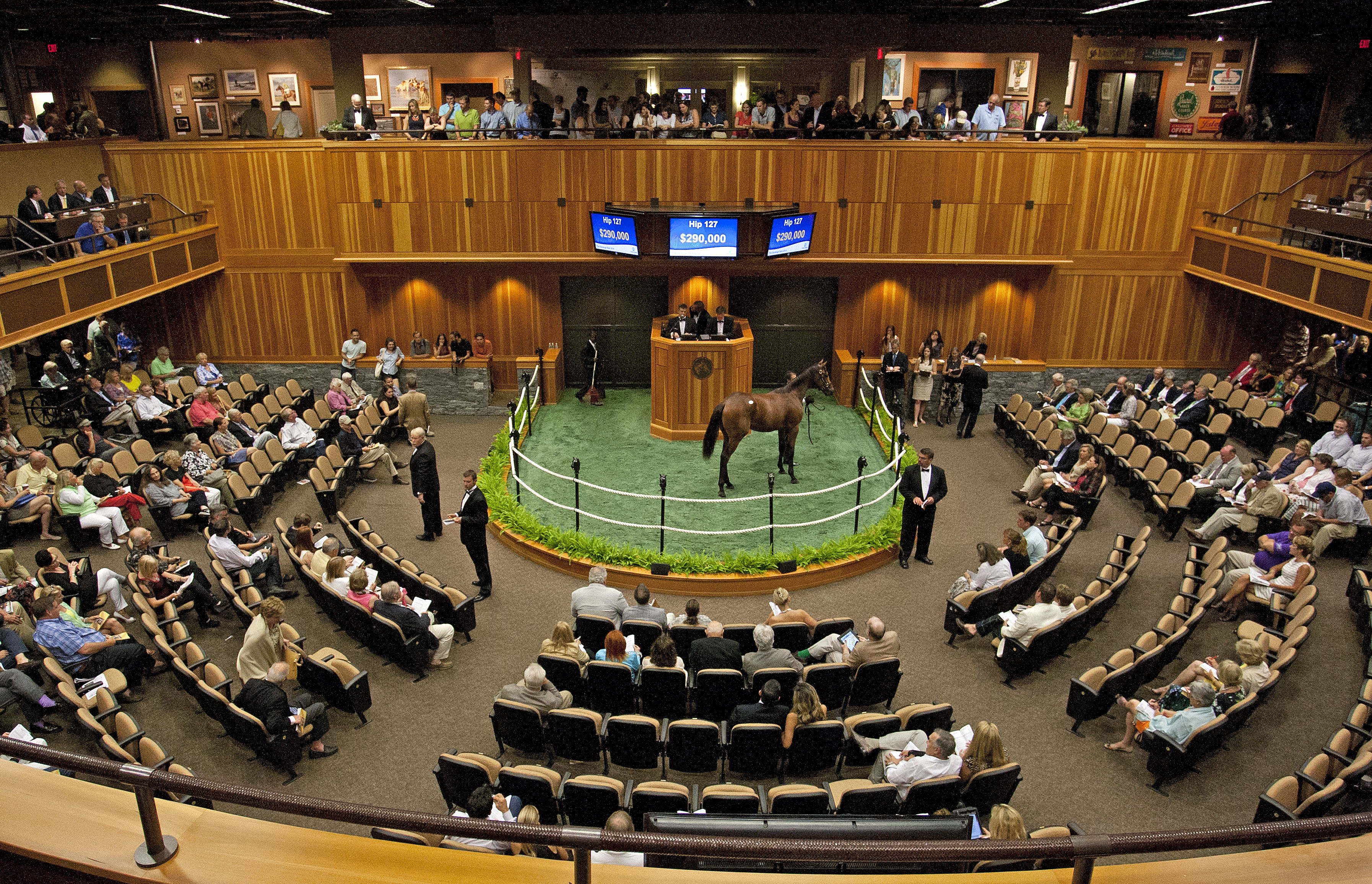
With vaccinations becoming more widespread and the pandemic hopefully receding, Fasig-Tipton is back with a full slate of sales this year, including what it has dubbed “the sale of a century.” The 100th edition of the Saratoga selected yearling sale will be conducted Aug. 9 and 10 at the Humphrey S. Finney Pavilion, which is named for an iconic figure in company history.
Download the 2021 Saratoga Sales Preview
“I think we’re all very proud of the sustained and consistent excellence of the quality of horses that have been offered at Saratoga, and those trends continue,” Browning said. “It has stood the test of time, and interestingly enough, we had a record sale the most recent Saratoga sale. It certainly continues to be a highlight of the yearling marketplace, and we think we’ve got an exceptional group of horses in the catalog for 2021.”
The consignors preparing to present this year’s stock also are enthusiastic about returning to their sale barns nestled in the Saratoga Springs residential neighborhood adjacent to the racetrack grounds.
“Just to be able to take part in something with that type of history – it has a real aura about it,” said Allaire Ryan, director of sales for Lane’s End. “You’ve got the racetrack right there, and you have the best of the best sale yearlings. You have everybody coming in – it really is an event that you can’t miss.”

In addition to offering some of the standouts of the yearling crop, with horses selected for the exclusive catalog based on pedigree and physical conformation, the Saratoga sale offers a unique and rich social scene. The sale is held during the height of the race meet, just days following the Grade 1 Whitney and the National Museum of Racing and Hall of Fame induction. In addition to industry participants, fans and onlookers flock the grounds to rub elbows with racing’s elite.
The facility, silent in 2020, is expected to again be packed on sale night. Some of the onlookers will be friends and family members of consignors and staff, enjoying the resort town and summer setting.
“Saratoga is the one time that for me, with my family, we do it together,” said Mark Taylor, vice president of sales and marketing for his family’s Taylor Made Sales Agency, a perennial leading consignor. “Everybody works, everybody’s there. We enjoy spending time with our friends and our customers and our team.
“It’s a business trip, but it’s also kind of just good bonding. A lot of great memories we’ve made up in Saratoga.”
At the end of the day, however, the Saratoga selected yearling sale is all about the horses – and the company has traded some legends during its history. Here is a snapshot look at some of the all-time greats who have sold in Saratoga, along with other key moments in Fasig-Tipton’s local history.
1898: Fasig-Tipton was founded by William B. Fasig and Edward A. Tipton. The New York City-based company, which was established to sell high-class riding and carriage horses in addition to Thoroughbred and Standardbred racehorses, initially held sales at Madison Square Garden and the metropolitan-area tracks.
1917: Under the leadership of Enoch James Tranter, who had taken over the company after the deaths of Fasig and Tipton, Fasig-Tipton partnered with some of the leading Kentucky breeders to ship their best yearlings north by railway and to present them to racing’s elite participants during the popular race meeting in Saratoga. Tranter arranged to purchase land in Saratoga near the racetrack and to build a sales facility. The sales were held throughout the month during that first season.
1918: In an event that would give this sale early clout, one of racing’s all-time greats, Man o’ War, was purchased for $5,000 by Sam Riddle when offered in Saratoga by breeder August Belmont Jr.
Belmont, who was serving overseas during World War I, had originally intended to race the colt himself. However, with the war effort ongoing, he elected to sell the colt with the rest of his yearling crop, which he shipped to Saratoga to sell as individuals after offering a package deal on the group at his farm was unsuccessful.
1923: Flying Ebony sold at Fasig-Tipton Saratoga as a yearling before going on to win the 1925 Kentucky Derby. He became the first of several Derby winners to graduate from the Saratoga sale, joined in following years by Cavalcade (1934 Derby), Gallahadion (1940), Kauai King (1966), Foolish Pleasure (1975), Go for Gin (1994), Monarchos (2001), and American Pharoah (2015).
1936: Bull Lea was purchased for $14,000 by Calumet Farm’s Warren Wright Sr. He went on to lead the American general sire list five times while shaping the historic Calumet dynasty, siring Triple Crown winner Citation; fellow Hall of Famers Armed, Bewitch, Coaltown, Twilight Tear, and Two Lea; Kentucky Derby winners Hill Gail and Iron Liege; and Preakness winner Faultless, among others.
1937: Humphrey S. Finney served as announcer for his first Fasig-Tipton sale. He would eventually rise to become president of the company.
1943: During World War II there was a shortage of railroad cars, with priority in freight going to war-related items. With the railroads not available for Kentucky’s breeders to send their yearlings to Saratoga, the sale was suspended from 1943 through 1945.
1952: Finney and Joe O’Farrell expanded Fasig-Tipton operations to conduct its first 2-year-olds in training sale at Hialeah Park. The same year, Finney gathered a group of investors to purchase the auction company and took over its presidency, stepping back only to hand the reins to his son in 1968.
1958: The filly Natalma was purchased by Canadian business mogul E.P. Taylor for $35,000 in Saratoga. She went on to produce the great dual classic winner and champion Northern Dancer, giving the Saratoga sale a prominent link to one of the greatest and most influential sires of all time.
1959: The Saratoga Chamber of Commerce recognized Fasig-Tipton as Saratoga firm of the year, noting that at the time, Saratoga was the only place that the company owned property and paid taxes. The local newspaper, The Saratogian, wrote that the company “is considered by business interests as an important factor in the economy of the community.”
1962: Raise a Native was purchased by Louis Wolfson for $39,000 in Saratoga. He went on to become a prominent sire – represented by the likes of dual classic winner and Hall of Famer Majestic Prince – and a sire of sires, with his sons including classic sires such as Alydar, sire of Easy Goer and Strike the Gold; Exclusive Native, sire of Triple Crown winner Affirmed; and the great Mr. Prospector.
1968: The Humphrey S. Finney Pavilion opens in Saratoga Springs, on the corner of East Avenue and George Street, a stone’s throw from the main gate of Saratoga Race Course. The Saratoga auctions have been held at this location ever since.
1978: Danzig was purchased by Henryk de Kwiatkowski for $310,000 at the Saratoga yearling sale. He went on to become one of Northern Dancer’s most influential sons at stud, with his sons including the great Danehill as well as War Front, one of the most prominent stallions standing in North America today.
1984: A son of Northern Dancer sells for $4.6 million to establish a Fasig-Tipton Saratoga record price, smashing the previous high-water mark of $3 million paid for a Spectacular Bid colt the year before. The colt, out of the Stage Door Johnny mare Bubbling, was purchased by the BBA Ireland, represented by Tom Cooper. Named Parlando, the colt never raced.
1985: A daughter of Alydar sold for $2.7 million to Mike Rutherford to become the highest-priced filly ever sold at Fasig-Tipton Saratoga. Later named Milliardaire, the filly, out of the Irish Castle mare Priceless Fame, started twice at age 4, winning both outings.
1991: Prominent New York breeder John Hettinger, founder of Akindale Farm in Pawling, stepped in at a crucial period in the history of the company after the bloodstock market declined in the late 1980s. In December 1991, Hettinger and his family funded a significant portion of the firm’s recapitalization plan. The Hettinger family became majority shareholders of the company, with 58 percent of the voting control.
2001: The Saratoga sale trades 162 yearlings for gross receipts of $62,412,000, resulting in an average price of $385,259 and median of $235,000. The figures are records for gross and average at the historic sale, which takes place a month before the Sept. 11, 2001, attacks impact the fall marketplace. With the economic crash of 2008 also looming, the record figures stand for many more years.
2008: Fasig-Tipton reached an agreement with Synergy Investments Ltd. to sell the auction company. Synergy is headed by Abdulla al Habbai, a close associate of Sheikh Mohammed bin Rashid Al Maktoum, the ruler of Dubai and founder of the international Godolphin racing and breeding operation.
2010: The first major renovations since the opening of the Humphrey S. Finney pavilion were completed with interior construction including theater-style seating, improved ground-floor accessibility, a buyers’ lounge, and a new press box. The previous year, the company had renovated the exterior facilities, constructing a new walking ring and holding area, and expanding the refreshment and restroom amenities.
2013: American Pharoah, who would break a 37-year drought and become the sport’s long-awaited Triple Crown winner, became the first Triple Crown hero to be sold at Fasig-Tipton Saratoga. The colt was sent through the ring by owner-breeder Ahmed Zayat, who purchased him back for $300,000 via bloodstock agent David Ingordo.
2018: With the sales market rebounding a decade after the economic crash, 170 yearlings are sold for $62,794,000, with an average of $369,376 and median of $300,000. The gross sales establish a record, the average is second-best only to the 2001 edition, and the median ties a record that had been established the prior year.
2019: The most recent edition of the Fasig-Tipton Saratoga sale is another record edition, a high bar for the 100th sale to top. With 135 yearlings sold for $55,547,000, the sale recorded its third-highest gross of all time. The average was $411,459 and the median was $350,000, both new records.
This story appears in our special edition previewing the 2021 yearling sales season. You can download the complete special edition as a PDF by clicking here.