

50 years after birth of Secretariat, Virginia racing and breeding attempts revival
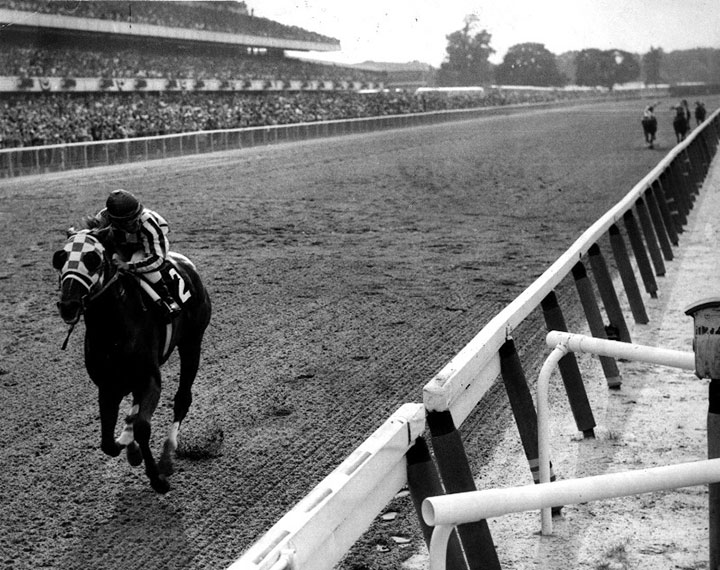
It has been half a century since the birth of Virginia’s most famous equine son – record-shattering Triple Crown winner Secretariat. The 50-year anniversary of his birth provides a chance to look back on the history of Thoroughbred breeding in the state, even as the state looks forward. Last season’s return of racing to Colonial Downs was a key point for the Virginia industry, which has worked hard to keep local farms and training centers afloat, and could now be finding some relief.
“Our motto is to add life,” John Marshall, executive vice president of operations at Colonial Downs Group, said in a press release. “We are adding life to New Kent County and Virginia during racing season and all year round.”
Secretariat, by Bold Ruler and out of Somethingroyal, was born on March 30, 1970, at The Meadow in Doswell, Va. The farm had been founded in 1805 by Dr. Charles S. Morris, an ancestor of Christopher Chenery. Chenery purchased the farm in 1936 and would transform it into one of the renowned racing stables of its time. Its blue and white colors are most famously associated with Secretariat, the 1973 Triple Crown hero and 1972 and 1973 Horse of the Year. He is one of four Virginia-bred Kentucky Derby winners, preceded by Reigh Count (1928), and followed by Pleasant Colony (1981) and Sea Hero (1993).
:: To stay up to date, follow us on: Facebook | Instagram | Twitter
Chenery died in January 1973, and the farm was sold in 1979, ultimately changing hands several times until Farm Bureau became sole owner in 2013. The property is now known as The Meadow Event Park and is a multi-purpose venue that is home to the State Fair of Virginia, the Virginia Horse Festival, regional horse shows, trade shows, weddings, concerts, and other events. Several of Chenery’s original equine structures still remain on the property, and five years ago, the Virginia Department of Historic Resources named The Meadow to the Virginia Landmarks Register, which was followed by addition to the National Register of Historic Places. The designation includes the foaling shed where Secretariat was born; the training barn where he was broken to tack; and several other structures.
“This designation is a fitting tribute to the land, our horses, and my father’s legacy,” the late Penny Chenery said at the time.
Tours of the historic equine facilities, including Secretariat’s birthplace, take place regularly at The Meadow, with one highlight a visit with the farm’s resident pensioned Thoroughbred, Groundshaker. The 9-year-old Quiet American mare, unplaced in two starts, was the final horse bred and raced by Penny Chenery, who died in September 2017.
A 50th birthday celebration for Secretariat that was planned for this weekend at The Meadow has been canceled due to the coronavirus pandemic, with Virginia among the states declaring a state of emergency. Meanwhile, some 46 miles from The Meadow, Colonial Downs will wait to see if the pandemic continues to be spread, or if it will abate in time for its racing season to open as scheduled in July, with the track looking to build on its successful comeback outing.
Colonial Downs originally opened on Sept. 1, 1997, and proved a valuable stop for turf 3-year-olds. The track’s signature race is the Virginia Derby, which was won by Kitten’s Joy in 2004 during his Eclipse Award champion turf season. It was later captured by English Channel (2005) and Gio Ponti (2008), both of whom developed into Eclipse Award champions as older horses. However, in the latter years of the track’s original run, management found itself at odds with the horsemen’s association over the race dates held at the track each year, and Colonial ultimately closed in 2014.
In April 2018, Virginia enacted a law to allow historical racing machines at the track and at Rosie’s gaming offtrack betting facilities in an effort to make it economically viable to reopen the track. And thus, live racing at Colonial re-emerged the following year under the new ownership of the Colonial Downs Group, a division of Peninsula Pacific Entertainment. In addition to its 1 1/4-mile dirt track, the facility also rechristened its turf course the Secretariat Turf Course. The 15-day meet, which ran from Aug. 8 through Sept. 7, was highlighted by the Grade 3 Virginia Derby and the Virginia Oaks, and several new stakes. The Rosie’s Stakes for 2-year-olds on the turf gained instant credibility as victorious Four Wheel Drive went on to capture the Grade 3 Futurity Stakes at Belmont and the Breeders’ Cup Juvenile Turf Sprint at Santa Anita in an unbeaten campaign. For the meet, Colonial reported that more than 36,000 people attended racing events and that the track’s total handle was $17.5 million, although 85 percent of those wagers were placed outside of the state. The track’s total purses were $7.4 million, a 55 percent increase over the 2013 meet, which ran over 24 days, with daily average purses of $492,000. In 144 races, averaging more than eight starters per race, Colonial reported that there were no racing or training fatalities.
Looking forward, the Virginia Racing Commission has approved 18 race dates this season for Colonial, with a meet running from July 23 through Aug. 29. The daily purses will tick upward to $500,000, with more than $2.8 million in stakes, including a robust Virginia-bred and -certified schedule.
“We are certain that our incremental growth plan will establish Colonial Downs as a premier destination for racing in the Mid-Atlantic region and beyond,” said Frank Petramalo, executive director of the Virginia Horsemen’s Benevolent and Protective Association.
While it remains to be seen if the coronavirus pandemic will impact this year’s meet, the return of racing to the state is a welcome outlet for horsemen. Over the past several years, with no in-state races for statebred horses, the Virginia Breeders Fund has worked to cultivate state breeding with its awards for Virginia-breds running around the country. The fund’s Virginia-certified program also has worked to support farms and training centers in the state by encouraging young horses to come to the state despite the lack of a racing outlet. Any horse conceived and foaled outside Virginia but maintaining residency in the state at a registered farm or training center for six consecutive months prior to Dec. 31 of their 2-year-old year is eligible for bonus money when winning at a track in any of the Mid-Atlantic states.
But with the new availability of statebred races, there is additional incentive to breed horses within the state – a welcome boon, as the shrinking foal crop nationwide is certainly in evidence in Virginia. The state’s foal crop was 614 in 1999, the farthest year back available in statistics provided by The Jockey Club. That number had dropped to 331 a decade later in 2009, and to 132 in 2014, the year Colonial closed. The 2019 Virginia-born foal crop numbered 58, and The Jockey Club reported just seven Virginia-sired foals born there. The breed organization also reported that 42 Virginia-bred foals were conceived in Kentucky, indicating that breeders were going out of state to take their pick of stallions, but were returning home to take advantage of incentive funds.
Those breeders could have additional stallions to choose from closer to home if activity does rise within the state. According to The Jockey Club’s Report of Mares Bred for 2019, active Virginia stallions were led by Friend Or Foe, who covered eight Thoroughbred mares, and J J’s Lucky Train, who covered six. Four stallions covered two mares each, and two stallions covered once each. Between the Virginia Thoroughbred Association’s database of Virginia-registered stallions for 2020 and third-party stallion registries which may include stallions not yet registered in the state, there are nine reported to be servicing racemares in the state in 2020, one more than last year.
One prominent newcomer is the regally bred Grade 1 winner Mr. Sidney at Riverview Farms in Mount Jackson. The son of Storm Cat is out of the Grade 1-winning A.P. Indy mare Tomisue’s Delight, a full sister to Horse of the Year and sire Mineshaft. Mr. Sidney previously stood in Kentucky and West Virginia.
:: DRF BREEDING LIVE: Real-time coverage of breeding and sales
The newcomers to the state will pose competition for Friend Or Foe, a New York-bred who is fashioning an unconventional but successful stud career in his adopted state of Virginia, with his offspring continuing to flourish back in his home state to make him Virginia’s leading in-state stallion with state-sired progeny in 2019. Friend Or Foe, who raced as a homebred for perennial New York leading owner-breeders Chester and Mary Broman, stands at Smallwood Farm in Crozet. The farm, which is owned and operated by Phyllis Jones and her daughter Robin Mellen, has been in operation for more than 50 years. Friend Or Foe has learned to jump since his retirement from the racetrack and is available as both a racing and sport horse sire, standing at Smallwood alongside the pony stallion Maple Side Wish List.
“We’ve bred everything from Clydesdales to event horses at Smallwood,” Jones told the Virginia Thoroughbred Association. Friend Or Foe’s “offspring have turned out to be wonderful and calm horses.”
The Bromans send a handful of mares from New York every year to support Friend Or Foe, and one of the products of that support is their 6-year-old homebred millionaire Mr. Buff. The eight-time stakes winner is in prime form, having won six of his last eight outings, most recently the Haynesfield Stakes on Feb. 22 at Aqueduct. His only losses in that span have been forays into Grade 1 company.
While Mr. Buff races as a New York-bred, there were 14 Virginia-bred horses who won stakes around the country in 2019, highlighted by Out for a Spin, winner of the Grade 1 Ashland Stakes at Keeneland. The daughter of Kentucky stallion Hard Spun, Out for a Spin was bred by the William M. Backer Revocable Trust, a longtime player in the state that was honored as the Thoroughbred Owners and Breeders Association’s state breeder of the year for 2018.
Leading breeder Backer died in 2016 and is one of several prominent Virginia horsemen who didn’t live to see this new era in the state’s history. Paul Mellon, who bred Sea Hero at his legendary Rokeby Stable, died in 1999. Edward Evans died in 2010. The legacy of his Spring Hill Farm in Virginia has spread nationwide, as his Virginia-bred multiple Grade 1 winner Quality Road stands in Kentucky and is among the nation’s leading sires.
Another historic Virginia property, Audley Farm of Berryville, hasn’t slowed down a bit – and has ties to both the glorious past of the Triple Crown that Secretariat swept and to the modern history and future of the series. Sir Barton, winner of the first Triple Crown in 1919, first stood at stud at Audley, and his best runner was the farm’s homebred Easter Stockings, the 1928 Kentucky Oaks winner and that year’s champion 3-year-old filly.
Audley Farm was acquired by the late German breeder Hubertus Liebrecht in 1978, and his family still owns the 3,000-acre farm, which also raises Angus cattle.
That history “makes you get up every day,” Audley equine manager Jamie McDiarmid said. “He obviously started kind of a crazy history with [the Triple Crown] if you think about it, because we’re all desperate to win it.”
Audley is a four-time Virginia breeder of the year, in 1995, 1997, 2002, and 2012. It got its first taste of modern Triple Crown success that final year, as Grade 1 winner Bodemeister, bred and sold by the operation, finished second in both the Kentucky Derby and Preakness Stakes and went on to sire 2017 Derby winner Always Dreaming in his first crop. Bodemeister is the most recent Virginia-bred to run in the Kentucky Derby.
Appropriately enough, Audley also bred the first foal by the most recent Triple Crown winner, Justify. The filly, out of Foreign Affair, was born in January at Amaroo Farm in Kentucky, where Audley boards some mares.