

2021 Keeneland September yearling sale ends with record average, median prices
LEXINGTON, Ky. – It was a safe bet that the Keeneland September yearling sale, which concluded Friday, would post improved figures from its 2020 edition, which was greatly hampered by the coronavirus pandemic. What wasn't expected was the level to which it would improve.
North America's bellwether yearling auction roared back with staggering improvements to its figures, including record average and median prices and a record-low buyback rate.
"I think that was the hope, was that we would return like last year never happened," said Tony Lacy, who took over as Keeneland’s vice president of sales this year as part of a new sales team. "Last year was a great sale, for the time, but this a return to a vibrant market."
Keeneland reported at the close of business Friday that 2,672 yearlings sold through the ring over 11 sessions arranged into five books for a gross of $353,823,000. Last year's sale, which took place over six books in 12 sessions, had 2,346 sold through the ring for a gross of $238,454,300 before any private sales were factored in. Last year marked the first time since 2016 the sale had not topped $300 million in gross receipts.

While the number of horses sold year-to-year was indeed up by 14 percent, the gross was up by a higher rate, at 48 percent. That spoke not only to competition in the bidding arena, but to the record buyback rate. The cumulative rate for 2021 was a solid 19 percent, compared to 29 percent last year. The buyback rate just squeaked in as a record, compared to 19.2 percent in 2012.
As expected, the highest buyback rates were seen in Book 1, where sellers may have the financial means to take the risk of retaining and racing their horses. The buyback rate for those two sessions early in the sale was 34 percent. After that, the figures consistently improved moving deeper into the sale, as urgency increased both from commercial breeders needing to move stock and buyers needing to fill their orders. Individual-session buyback rates were what Lacy termed "outstanding" late in the sale, finishing as low in places as 5 percent for session 11, 9 percent for session 9, and 12 percent in both sessions 8 and 10.
"There are a lot of happy sellers and happy breeders out there," Lacy said. "That's a great sign for the industry. . . . The clearance rate is a very strong indicator of the strength of where we're at."
The cumulative average price for horses sold through the ring at Keeneland September was $132,045, spiking 30 percent from the comparable figure of $101,643 last year – again, not factoring in post-ring private sales that Keeneland adds to later figures available online. The previous record figure was $129,331, established in 2018.
The overall median was $65,000, soaring 76 percent from $37,000 in 2020. The prior record was $57,000, established in 2017.
Keeneland sales officials were particularly pleased with the median, as that figure indicates the status of the marketplace across its breadth, not being as influenced by high-dollar horses as the average price can be. Every session of the sale but the first one showed a year-to-year improvement of the median; three sessions improved by more than 75 percent, with session 9 doubling its median.
"The median is consistently very strong," Lacy said. "It's a very important indicator for the health of the market in general. The median is the most important number for us."
Book 1 opened the sale with its usual run of high-ticket horses, with 11 seven-figure offerings in all on Sept. 13-14. That book was led by a $1.6 million colt by Quality Road, who stands at Lane's End Farm. W.S. Farish, Jr. of Lane's End and its affiliated Woodford Racing signed the ticket for the colt on behalf of a partnership that also will include West Point Thoroughbreds. Barbara Banke of Stonestreet Stables, which bred the colt and consigned him via Eaton Sales, said she will come back in to retain a piece of the colt, as is her common practice when selling colts from her high-end broodmare band.
The colt is out of the remarkable broodmare Catch the Moon. The unraced Malibu Moon mare has produced four graded stakes winners by four different sires, including Grade 1 winner Girvin and of classic-placed Midnight Bourbon, who continues to enhance the family's reputation this season.
Powered by that colt, Quality Road finished as Keeneland September's leading sire by average price among stallions with three or more yearlings sold. His 34 yearlings sold averaged $472,794.
“The thing you have to remember is that [Quality Road's] 3-year-old crop is out of $35,000 stud fees, which was the lowest point of his quality of mares and number of mares booked," bloodstock agent David Ingordo noted. "These 2-year-olds are out of $70,000 stud fees. Now you’re seeing the [yearlings out of mares bred for] $150,000 in the market, and this year’s foals are out of $200,000. With the quality of mares he’s got, he’s on par with [other top stallions] in the country. You’re seeing the results of those better mares with the higher stud fees. The most important thing is that he produces on the racetrack.”
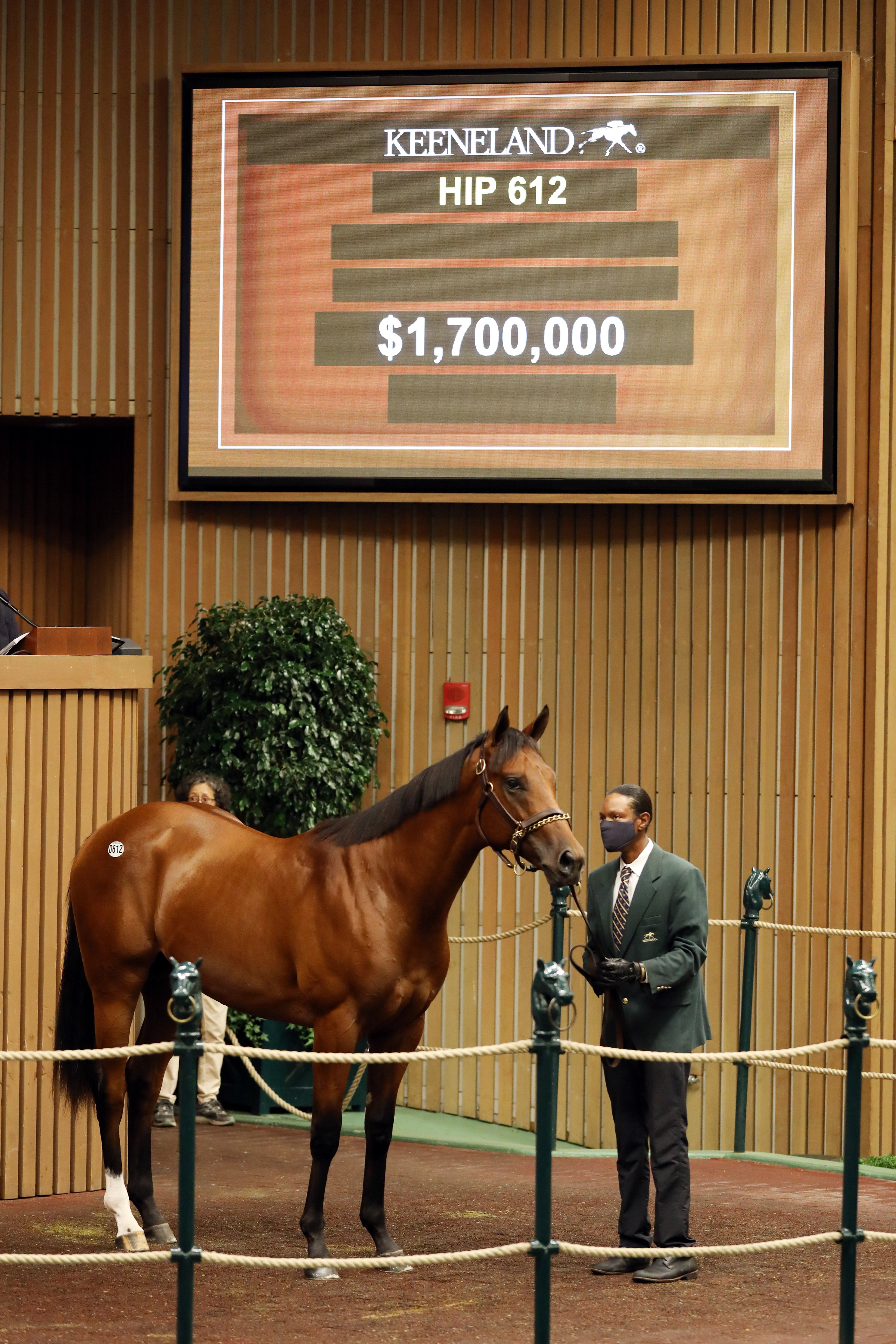
Quality Road got another feather in his cap as the sale-topper actually emerged from a blockbuster Book 2 that followed on Sept. 15-16. A colt from the first crop of Quality Road's son City of Light sold for $1.7 million to top the sale. Keeneland sales officials could not remember a September sale-topper having emerged from outside the marquee Book 1 portion in at least 15 years.
With the City of Light colt leading four seven-figure horses in Book 2, that portion of the sale finished with a 34 percent gain in its average, compared to a 7 percent gain in Book 1. That set the table for the continued strength of the middle market during the second week of the sale. Book 3 showed a 56 percent gain in its average price compared to 2020; Book 4 had a 60 percent gain; and Book 5 finished with a 6 percent gain.
City of Light, winner of the Breeders' Cup Dirt Mile and Pegasus World Cup, stands alongside his sire at Lane's End. Woodford Racing and West Point teamed up with a third entity, Mike Talla's Talla Racing, to make the purchase of his sale-topping colt.
“City of Light was one of the most brilliant horses we have seen on the track arguably in the last 10 years," bloodstock agent Jacob West said. "And it looks like he is passing on that athleticism."
The colt, out of the stakes-placed Tapit mare Anchorage, provided one of the fairy-tale stories of the sale, as he was bred and consigned by Rosilyn Polan, who has just eight mares at her Sunday Morning Farm.
The three sale-leading horses were all purchased by multi-pronged partnerships, and bloodstock agents shopping on behalf of partnerships were the two overall leading buyers by gross. Those figures continued a trend in the marketplace in recent years, with buyers teaming up to spread their risk rather than going head to head in the ring.
"It’s incredible that the business has evolved, and it just goes to show you, if you’re in an industry that’s evolving, you have to evolve yourself," said Terry Finley of West Point. "That’s what we’ve worked hard to do is to evolve, and we’re just part of a team. We like to think we’re good partners, and we bring on good partners. We all do our own thing, and it’s a special thing. These horses are very hard to buy, and I just couldn’t do it without an immense amount of support and people who are in a position to take chunks.
“I don’t necessarily abide by the notion that these partnerships are bad for the sellers," he continued, "because oftentimes, you might get two of these groups [that bid against each other]. So everything evens out. . . . You can’t mess with the market. The market is what the market is.”
West, shopping for Mike Repole's Repole Stables and the St. Elias Stable of Vinnie Viola, finished as the sale's leading buyer by gross, signing for 43 horses for a total of $16,045,000. The partnership's last purchase at the sale came in Book 4.
The partnership of SF Bloodstock, Starlight Racing, and Madaket Stables, represented by Donato Lanni, tied with bloodstock agent Mike Ryan, shopping for various clients, as the sale's second-leading buyers by gross, both also shopping into the later books en route to spending $10,590,000 each. With strong competition at the top of the marketplace, high-end buyers were purchasing horses perhaps later than normal in the second week of the sale, creating more urgent competition. That was continually cited as a factor in the improved figures, along with pent-up market enthusiasm and optimism for the state of racing and purses in general.
"They've been pushed back maybe a little bit further than in years past, and maybe that's why we're seeing the numbers and the clearance rate," Keeneland director of sales operations Cormac Breathnach said.
Lanni and West, who also were the top two buyers by gross for their respective partnerships in 2020, are among the domestic buyers who continue to dominate the North American buying bench due to travel difficulties causes by the ongoing pandemic. International participation did increase for the 2021 edition, with buyers in attendance from Japan, Europe, Australia, and other nations. However, some major players were still missing.
Brian Graves, general manager for consignor Gainesway, noted, in particular, the absence of Godolphin – whose Sheikh Mohammed al-Maktoum has frequently traveled to this sale in the past – and the late Sheikh Hamdan al-Maktoum's Shadwell.
Godolphin and Shadwell were the top two buyers by gross at the final pre-pandemic Keeneland September sale in 2019, spending $16 million and $11.07 million, respectively. Neither outfit made a purchase this year, with Shadwell, following the death of Sheikh Hamdan in March, recently announcing its intent to pare down its stock.
"There's an absence of Shadwell, Sheikh Mohammed, and lots of people didn't have travel waivers to get here," Graves said. "When you start adding that up, you feel like there's $30 million or $40 million that could possibly be missing in the marketplace. But the domestic buyers stepped up, and they got their hands on some of these things that those other guys usually do. Lots of partnerships and lots of active people here domestically propped it up."
Breathnach also noted the strength of the domestic marketplace.
"One of the most encouraging things has been the activity from domestic end users," he said. "For a long time, that's been something we've wanted more of. The international participation has been very good. The Japanese market was very strong and participated a great deal. Coolmore in Ireland is here, the Irish pinhookers are still here. The international market is not to be discounted, [but] domestic end users have pushed a lot of activity into later books as well."
Lacy and Breathnach head up the new Keeneland sales team behind organization president Shannon Bishop Arvin, who is less than a year into her tenure at the helm. The changes to the sales team came after former director of sales operations Geoffrey Russell retired from his full-time position earlier this year after 25 years with Keeneland; he remains in an advisory role.
The new team continued the process of tweaking the format of this year's sale in response to feedback, looking to put what both Lacy and Breathnach called a "critical mass" of horses in front of buyers at any one time. Last year's Book 2 began after the single dark day off from the sale following Book 1. This year, Keeneland positioned Book 2 immediately after Book 1 – the dark day came before Book 3 – in order to show buyers more horses during the week and to keep the momentum from the opening sessions. Likewise, at the end of the sale, where 2020 featured shorter sessions in Books 5 and 6, the final sessions were condensed into a three-session Book 5 to generate more competition. The results spoke to the format's success.
Another innovation for the staff early in the sale was the introduction of the RNA Reoffer program, attempting to address some of the concerns of breeders and consignors who felt disadvantaged by drawing an early placement in the catalog, or who feel they misjudged the early market. The second Book 1 session on Sept. 14 was immediately followed by a selection of yearlings who failed to meet their reserve during the opening session whose connections wanted another chance in the ring.
Seven yearlings were entered in the RNA Reoffer program, with three selling privately beforehand, and one of the remaining four selling in a second trip through the ring. That horse, a More Than Ready colt, drew a high bid of $150,000 after he had been a $145,000 buyback in the opening session.
Consignors were pleased with the addition of the safety net.
“I think it’s great that they’re trying new things and different things," Greg Goodman of Mt. Brilliant Farm said. "Hopefully, I won’t have any horses that I [have to] think about putting in there! But I think with the new Keeneland team, I think they’re doing a great job, and I think they’re going to try new things as we go, and this is one of them. It’s a good effort.”
Behind the aforementioned Quality Road as the new-look Keeneland September sale's leading sire by average price, among those with three or more sold, came Hill 'n' Dale resident Curlin (36 sold for average of $428,250) and Spendthrift's Into Mischief (62 for $418,823). Rounding out the top five by average were the sale's leading first-crop sires, as City of Light (47 for $372,872) checked in just ahead of Triple Crown winner Justify (61 for $367,721), who stands for the Coolmore group.
Into Mischief, North America's two-time reigning leading sire, led the way by gross sales for the second consecutive year at Keeneland September, with his offspring fetching a combined $25,967,000.
"Into Mischief, I don't recall a sire in my lifetime like him," said bloodstock agent Mike Ryan. "He's extraordinary. Just extraordinary."
Following Into Mischief atop the gross sales leaderboard were Justify ($22,431,000) and City of Light ($17,525,000).
The leading consignor by gross sales, for the seventh consecutive year and the 17th time in the last 20 years, was Taylor Made Sales agency, which sold 304 horses across all six books for a total of $37,306,500.
The bloodstock community mourned the loss of two well-known consignors during the run of the Keeneland September sale, during which both had active consignments. Mike Recio, the co-founder of South Point Sales, died Sept. 16 at age 46 following a long battle with sepsis. Three days later, James M. Herbener Jr., who consigned horses under his own name, died of a suspected heart attack at age 69.
For hip-by-hip results for Keeneland September, sortable by session, click here.