

Watchmaker: How will history judge Justify if he's done racing?
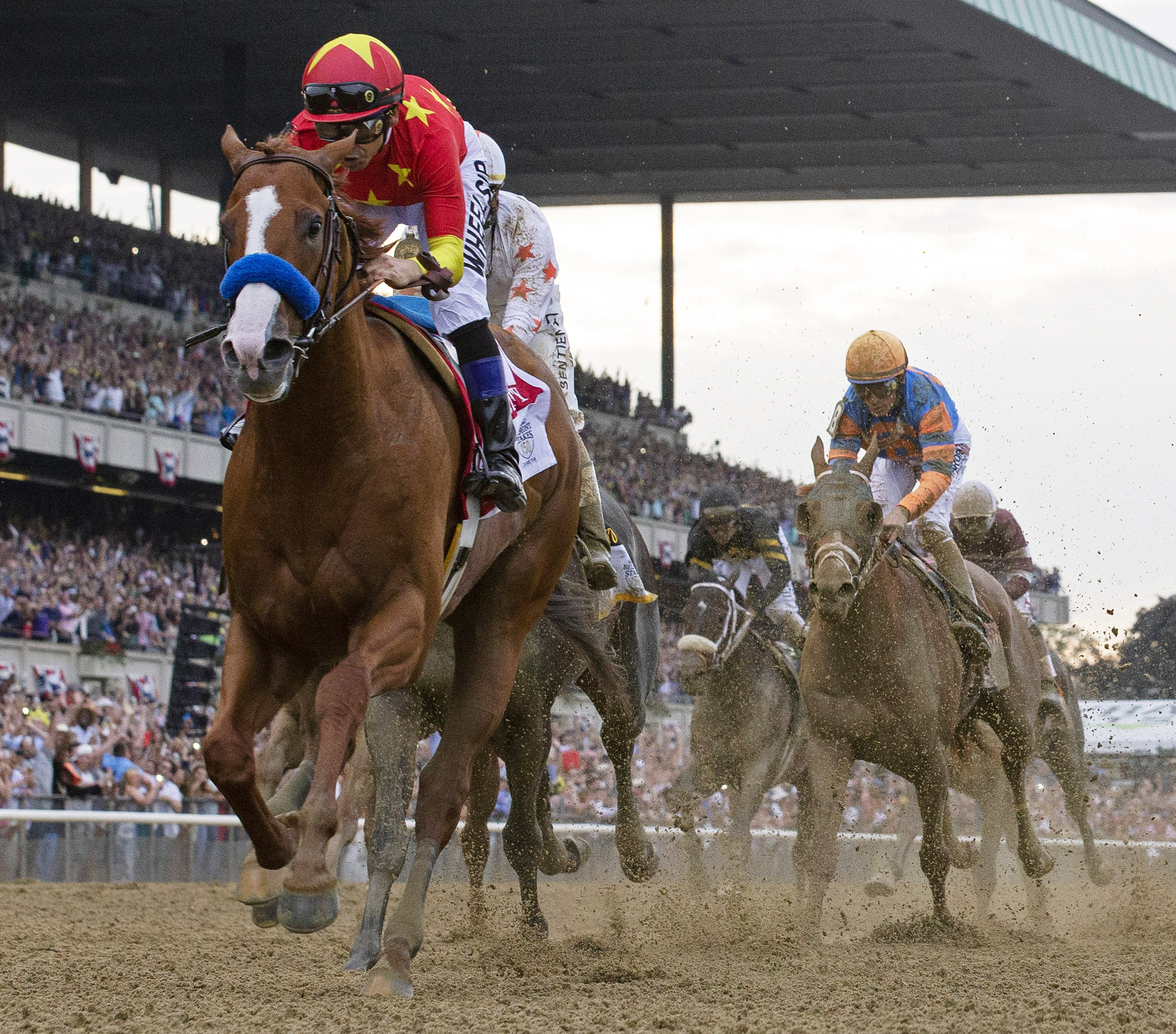
If what most folks anticipate does indeed come to pass and Justify retires to stud without having raced again after his sweep of the Triple Crown, many will hold him up as an example of what’s wrong with the sport today.
I understand the complaint. In a career that would have spanned only six starts over a four-month period from Feb. 18 to June 9, Justify would be an extreme example of an equine star leaving the game far too soon.
But I understand the other side of the debate, too. What sense does it make to risk Justify in any way when he is worth somewhere in the vicinity of $60 million as a sire? Who among us would turn their backs on that kind of money if we were in the position of making that call?
Sure, it feels like we’ve barely gotten to know Justify. It is, in fact, largely guesswork assessing just how good a racehorse he really was. But while another two or three starts from Justify might have helped clarify that, two or three more Justify starts were not going to address the game’s biggest issues, such as cultivating a truly loyal fan base that bets a couple of hundred dollars a couple of times a month instead of courting transient support that comes to the track twice a year, spends a couple of hundred bucks on drinks and food, and puts $30 through the windows.
And if Justify isn’t 100 percent and isn’t primed to deliver the very best he has in competition, then it does no one any good for him to come back and throw in a couple of mediocre performances that leave those who fell in love with him and/or respect him feeling fooled.
For me, if we have seen the last of Justify in competition, the more interesting topic of discussion concerns his place in racing history. He already has carved out a pretty significant one for himself. That’s automatic when you have managed to accomplish what only 12 other horses have been able to do and sweep the Triple Crown. But there is more, even if his career was so brief. Justify, of course, was the first horse in 136 years to win the Kentucky Derby without having raced as a 2-year-old. He became only the second undefeated Triple Crown winner but was the first Triple Crown winner not to have raced as a 2-year-old.
I suspect Justify’s place in racing history will be determined in no small part by how he ranks against his fellow Triple Crown winners. And my sense is Justify has an uphill battle in that regard if he has indeed run his last race, primarily because he has run his last race.
Consider what these Triple Crown winners did after their Triple Crown sweeps:
• Whirlaway (1941) raced 33 more times at 3, 4, and 5, and won 18 of those starts.
• Assault (1946) raced 27 more times through age 7 and won 11 of those races.
• Citation (1948) started 25 more times despite being hobbled by an osselet injury that kept him out for all of his 4-year-old year and compromised him to no small extent as a 5- and 6-year-old, and yet he still won 14 more times.
• Sir Barton (1919) made 21 more starts at 3 and 4 and won nine of them.
• War Admiral (1937) made 15 more starts through age 5 and won 13 of those outings.
• Affirmed (1978) started 13 more times at 3 and 4, won eight of them, and finished first in another (the 1978 Travers) only to be disqualified for interference.
• Seattle Slew (1977), the only other horse to remain unbeaten through his Triple Crown sweep, made eight more starts at 3 and 4 despite getting deathly ill early in his 4-year-old year and won five of them.
• Omaha (1935) made seven more starts through age 4, winning four of them. That included four starts in England at 4, winning two of them and losing the other two in photo finishes.
• Gallant Fox (1930) and Secretariat (1973) both made six more starts at 3 following their Triple Crown sweeps, with Gallant Fox winning five of them and Secretariat winning four of them. Notably, all of Secretariat’s starts at 3 came after he was syndicated for stud for just more than $6 million, a record at the time.
• Even the very recent American Pharoah (2015) made three more starts at 3 and won two of them. Don’t you now have a new appreciation for American Pharoah making his post-Triple Crown starts? I do.
The only Triple Crown winner who is somewhat analogous to Justify is Count Fleet (1943).
Count Fleet did not race again after he completed his Triple Crown sweep, but that was not the plan for him at all. Count Fleet came up with an ankle injury and a splint that eventually caused him to be put away for the remainder of his 3-year-old season. He was to have raced as a 4-year-old and was, in fact, put back in training, but a string of additional injuries ultimately led to his retirement. Nevertheless, Count Fleet was no unfamiliar shooting star. His Belmont Stakes was his 21st career start and his 16th victory.
Yet, when the discussion turns to our great Triple Crown winners, even those steeped in racing history rarely hear or invoke Count Fleet’s name. You hear about Secretariat, of course, and you hear about Citation (or you should; if you don’t, you’re talking to the wrong people), who was a Secretariat/Forego mashup of his era, and you hear about Affirmed because of his great rivalry with Alydar. But you don’t hear Count Fleet mentioned very often, if at all, even if he was by the most critical, if subjective, assessments better than close to half of all the Triple Crown winners.
As unfair as it might be, I sense that’s because Count Fleet didn’t race again after his Belmont. It’s as good an explanation as any. And while in my mind he’s certain to be Horse of the Year and a first-ballot Hall of Famer when that time comes, I suspect racing history will be similarly cold to Justify.
Saturday notes:
• Catalina Cruiser’s breakout win in the San Diego Handicap at Del Mar was most welcome for what it might mean for an older dirt male division that can use all the quality depth it can get. And now Catalina Cruiser is unbeaten and largely untested in his three career starts, and with a preliminary San Diego Beyer Speed Figure of 107, he has paired up 107 Beyers in his last two starts.
That said, five program scratches, most notably the formidable Accelerate, knocked the San Diego down to a fairly soft field of five. And the pace Catalina Cruiser controlled appeared to be a very easy and forgiving one (I say “appeared to be” because there were no other dirt routes on the card to compare it to). In other words, it would have been a head scratcher if Catalina Cruiser didn’t win big. But it’s good that he did, and now let’s see him follow it up when the conditions and the competition aren’t so favorable.
:: Clocker Reports: Get in-depth workout analysis for Del Mar & Saratoga
• The only two times Sistercharlie has lost here in the U.S. – when second, beaten a neck, in last year’s Belmont Oaks in her U.S. debut and second, beaten a head, in last month’s New York Stakes – she was much too far back early. Sistercharlie was still off the pace in the Diana at Saratoga but not nearly as far back early as in those narrow defeats, and that made the difference as she got up in time to remain the ranking turf female in the country.
However, A Raving Beauty was unlucky to be only a close third in the Diana after taking up at a crucial point nearing the stretch, losing all of what appeared to be potentially winning momentum. I don’t think there is much difference at all between Sistercharlie and A Raving Beauty.
And, to the surprise of no one, Chad Brown trains both.
