

Two $20 bets, and they're off to sports betting in New Jersey
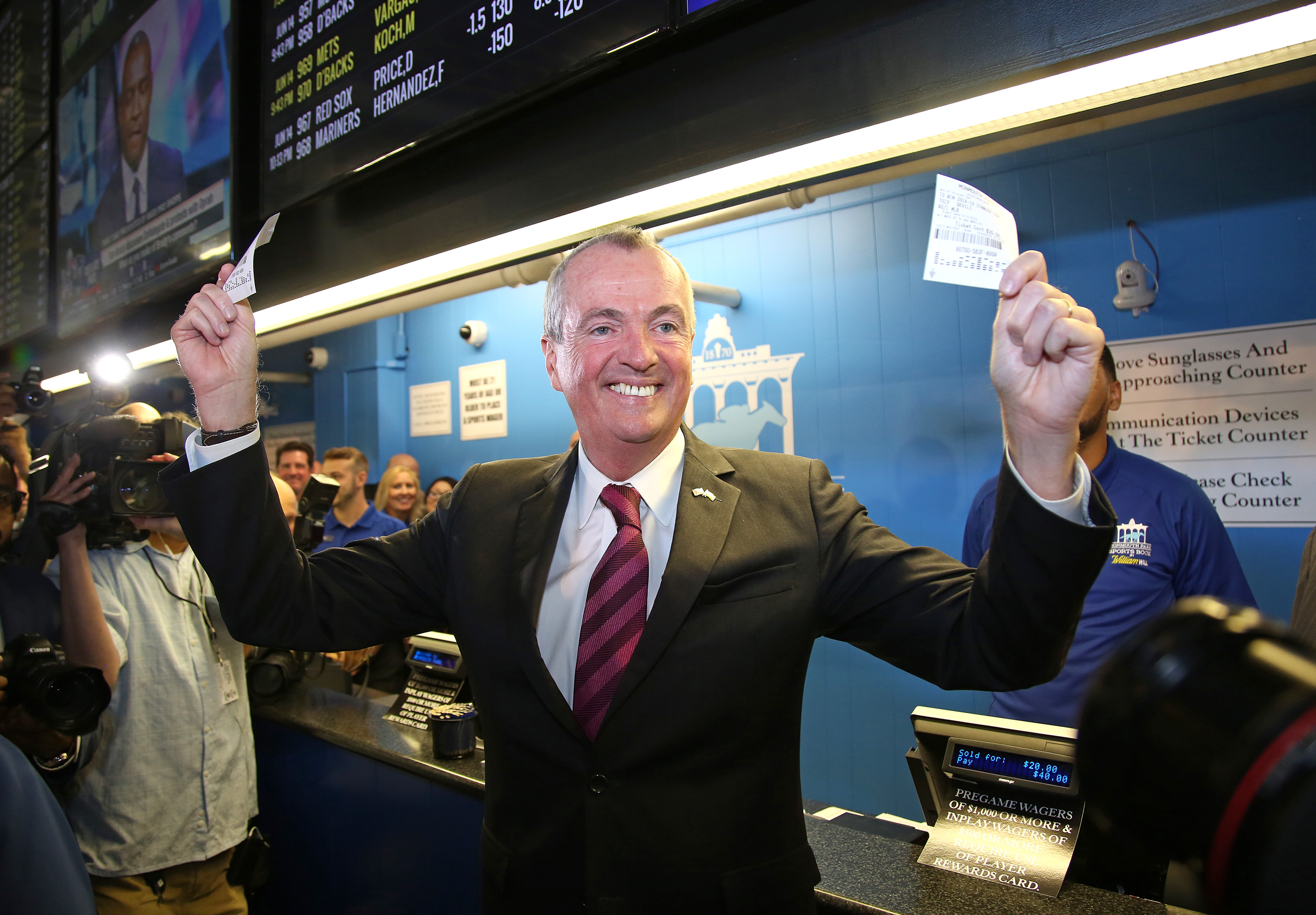
OCEANPORT, N.J. – After seven years of legal wrangling, the battle to legalize sports betting in New Jersey came to fruition at Monmouth Park on Thursday morning at 10:30 a.m. when Gov. Phil Murphy placed two $20 wagers. He bet Germany to win the World Cup and the New Jersey Devils to win the 2019 Stanley Cup.
“We have successfully eliminated an unlawful, unfair federal law that prohibited sports betting,” Murphy said. “This is a huge step forward for the tracks, casinos, and the state of New Jersey. There are lots of good times ahead.”
The only other site in the state to open for sports betting Thursday was the Borgata in Atlantic City. Murphy was headed there to speak after he left Monmouth.
Retired state Sen. Ray Lesniak, who led the fight for legal sports betting, also spoke before the betting windows opened to the public.
“We have worked on this under three governors, Jon Corzine, Chris Christie, and now Phil Murphy,” Lesniak said.
A crowd of several hundred people were on hand to hear Murphy, Lesniak, Dennis Drazin, the chairman of Darby Development – which operates Monmouth Park – and Joe Asher, the chief executive of William Hill, speak in a brief ceremony. When they were finished, long lines quickly formed at the betting windows.
The first soccer match of the World Cup, which pitted Saudi Arabia vs. Russia, began shortly after the betting opened.
In addition to soccer, the Thursday wagering menu included baseball. The betting options included money lines, alternative runs lines, and totals wagering.
The available future wagers being offered included the World Cup, World Series, 2019 Stanley Cup, 2019 NBA championship, and the 2019 Super Bowl.
The sports book was to remain open Thursday until the conclusion of the New York Mets evening game in Arizona against the Diamondbacks. The sports book will open at 8 a.m. this Friday, Saturday, and Sunday. Monmouth will have live race cards Saturday and on Sunday, Father’s Day.
Drazin said sports betting assures that racing at Monmouth Park will operate at a high level for years to come.
“The track was always going to survive,” he said. “I committed to preserve it and would have done whatever was needed to do so. But Monmouth Park is a jewel and it would not have been possible to keep it at a world-class level without sports betting. All the surrounding tracks have lots of extra revenue from casino gaming.”
In anticipation of sports betting, Monmouth management partnered in 2013 with England-based bookmaker William Hill, which will set the betting lines and manage the sports book.
Although estimates of how much revenue sports betting will generate at Monmouth and in the state vary widely, Monmouth is uniquely positioned to benefit as the New Jersey Thoroughbred Horsemen’s Association leases the track from the state and operates the facility. This year’s Monmouth race meet consists of 52 programs.
“Our goal is to increase purses and add more racing dates,” Drazin said.
Drazin estimates that once the New Jersey sports betting market stabilizes, Monmouth could handle $1 billion a year.
“We think the illegal sports betting market nationally, offshore and books, is around $40 billion,” he said. “Because of the demographics in New Jersey, we think total betting will reach $10 billion annually.
“In a mature market, we think Monmouth will take in 10 percent of the state’s total handle.”
The push to legalize sports wagering in New Jersey dates to 2011, when voters approved a constitutional amendment to allow it. The New Jersey legislature and former governor Chris Christie attempted a number of ways to implement sports betting but were challenged by the sports leagues, which prevailed in a series of court rulings.
The Supreme Court ultimately agreed to hear the case and on May 14 threw out the 1992 Professional and Amateur Sports Protection Act, which prohibited betting on sports in all but a few areas of the country.
On June 7, the New Jersey Legislature passed Assembly Bill 4111, setting the framework for sports betting in the state. Murphy signed the legislation Monday.
On Wednesday, the New Jersey Racing Commission cleared the way for Monmouth to accept sports bets by passing emergency regulations until formal rules are adopted.
Sports betting will be permitted in New Jersey at Atlantic City’s nine casinos, the state’s three racetracks – Monmouth, Meadowlands, and Freehold – and sites of former racetracks.
Betting will not be allowed on college games that involve a New Jersey school or take place in the state.
Sports wagering income will be taxed at a rate of 8.5 percent. The rate for online sports wagering, which is expected to be introduced later this summer, will be 13 percent.
“The overall takeout, or win, in Las Vegas is 5 or 6 percent,” Drazin said. “William Hill generally does a little better and the take could be 6 to 8 percent.”
New Jersey was the second state in the country to open for casino gaming in 1978 and is the second state to begin sports betting since the Supreme Court decision. Delaware, which for the past 26 years had been allowed to accept parlay card sports wagers, on June 5 began accepting wagers on individual games and future wagers.
