

Simon: Closer look at Triple Crown race winners as sires
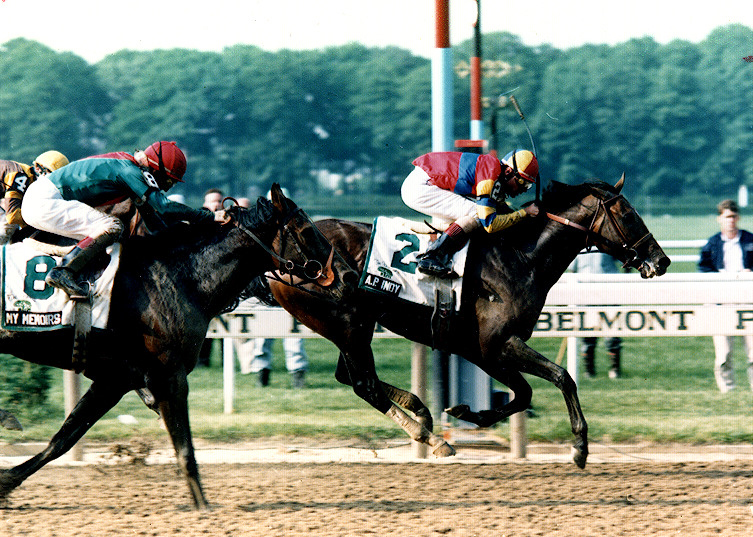
A classic race for males was started in England in 1780 to help breeders develop the emerging Thoroughbred, a cross of several breeds including Arabians, by testing the best 3-year-old colts at 1 1/2 miles in the Epsom Derby. The goal was to help find progenitors who could pass along the traits of speed and stamina necessary to improve the breed. That’s why the Epsom Derby to this day is restricted to entire colts and fillies. Geldings need not apply.
The importance of such a test was quickly embraced by the rest of the world as the sport expanded outward from England, and today there is a Derby, or Derby equivalent, in every major racing country.
In the United States, the three classics – the Kentucky Derby, Preakness, and Belmont Stakes – have long been used by breeders as measuring sticks for potential stallion prospects. A classic victory is worth millions in future stud fees, which is why these races – especially the Kentucky Derby – draw sizable fields almost every year.
But winning a classic race is not an automatic ticket to stud success, as breeders are all too aware, whether we’re talking about the Epsom or Kentucky Derby. Finding a horse that turns out to be a successful sire is no easy task, regardless of race record, pedigree, or conformation, though excellence in all three of those categories is usually a good place to start.
Since the classics were established to produce future influential sires, as America’s 2016 Triple Crown season ends with the Belmont on June 11, now seems a good time to look at how well these races have fared in producing successful sires.
To get an idea as to each race’s predictive qualities, we looked at the 20-year period from 1989 to 2008 to analyze how our classic winners fared as stallions – and to determine which race, if any, has been better at producing top sires. We also wanted to see if dual classic winners were more successful than those who had won just a single leg of the Triple Crown.
In the accompanying table, the individual race winners are reported along with a grade of their sire rating. On a scale from A to F, the ratings are based on total stakes winners from foals and total graded stakes winners from foals.
Winners of Triple Crown races as sires, 1989-2008
| Year | Kentucky Derby | Sire rating | Preakness | Sire rating | Belmont | Sire rating |
|---|---|---|---|---|---|---|
| 2008 | Big Brown | C | Big Brown | Da' Tara | F | |
| 2007 | Street Sense | B | Curlin | B | Rags to Riches | NA |
| 2006 | Barbaro | NA | Bernardini | B+ | Jazil | D+ |
| 2005 | Giacomo | C | Afleet Alex | B | Afleet Alex | |
| 2004 | Smarty Jones | C+ | Smarty Jones | Birdstone | C+ | |
| 2003 | Funny Cide | NA | Funny Cide | NA | Empire Maker | A- |
| 2002 | War Emblem | A- | War Emblem | Sarava | F | |
| 2001 | Monarchos | C- | Point Given | C+ | Point Given | |
| 2000 | Fusaichi Pegasus | C | Red Bullet | C- | Commendable | F |
| 1999 | Charismatic | D | Charismatic | Lemon Drop Kid | A | |
| 1998 | Real Quiet | D+ | Real Quiet | Victory Gallop | B | |
| 1997 | Silver Charm | D | Silver Charm | Touch Gold | C | |
| 1996 | Grindstone | C | Louis Quatorze | C | Editor's Note | C |
| 1995 | Thunder Gulch | B- | Timber Country | F | Thunder Gulch | |
| 1994 | Go for Gin | D | Tabasco Cat | C+ | Tabasco Cat | |
| 1993 | Sea Hero | D+ | Prairie Bayou | NA | Colonial Affair | D+ |
| 1992 | Lil E. Tee | C | Pine Bluff | B | A.P. Indy | A+ |
| 1991 | Strike the Gold | D | Hansel | C | Hansel | |
| 1990 | Unbridled | A+ | Summer Squall | A | Go and Go | D |
| 1989 | Sunday Silence | A+ | Sunday Silence | Easy Goer | A- |
NOTE: Sire ratings are based stakes winners from foals and graded stakes winners from foals. The average stakes winners from foals for the breed is 3.7% and the average graded stakes winners from foals is 0.8%. Those two factors are computed as a baseline rating of C. Sires who exceed those benchmarks are deemed better than average. For the top 1% of sires, the percent of stakes winners from foals is 7.8% and graded stakes winners from foals is 3.1%. Sires who met those two benchmarks earned a rating of A.
Since average percentage of stakes winners from foals is 3.7 percent and the average percentage of graded stakes winners from foals is 0.8 percent, those two numbers create a baseline rating of C – an average rating – for those sires that produce similar numbers. For example, Big Brown, who has 3.9 percent stakes winners from foals and 1.2 percent graded stakes winners from foals, has a sire rating of C because he falls neatly into the ratings of an average sire. Sires who exceed the average benchmarks get elevated ratings. Because the top 1 percent of all sires produce on average 7.8 percent stakes winners from foals and 3.1 percent graded stakes winners from foals, stallions who met those benchmarks earned a rating of A.
As can be seen in the table, individual race winners of the Triple Crown events are all over the statistical board. At the top of the scale are A+-rated sires A.P. Indy, Sunday Silence, and Unbridled.
From 1,224 foals of racing age, A.P. Indy sired a remarkable 13.3 percent stakes winners from foals and an even more extraordinary 7.2 percent graded stakes winners from foals. Unbridled had 8.2 percent stakes winners and 4.1 percent graded stakes winners. Sunday Silence, who spent his stud career in Japan, sired 11 percent stakes winners and 9.2 percent graded stakes winners.
At the other end of the spectrum are F-rated sires Commendable, Da’ Tara, Sarava, and Timber Country. Commendable got just 0.6 percent stakes winners and zero graded stakes winners from 350 foals; Da’ Tara – who stands in Venezuela – has yet to sire a known starter; Sarava produced a mere 1 percent stakes winners and 0.5 percent graded stakes winners; and Timber Country has been represented by 1.6 percent stakes winners and 0.3 percent graded stakes winners.
As a group, winners of the Preakness have fared better as sires. Based on a scale of 12 points for A+, 11 for A, 10 for A-, 9 for B, etc., on down to 0 for an F, the average sire rating for Preakness winners is 6.2 points. The average rating for winners of the Kentucky Derby is 5.4, and the average rating for Belmont winners is 5.6.
In other words, the Derby, the most sought-after race in America, has produced, on average, somewhat inferior sires than the other two races.
If you throw out the three F-rated Belmont winners, that race generates an average sire rating of 6.7, higher than the Preakness – which is odd since the Belmont is contested at 1 1/2 miles, a distance most horses never run in their careers.
Of course, you can’t just throw out certain classic-winners-turned-failed-sires, because when those horses went to stud people invested in them as breeding prospects – and they ultimately failed those who supported them.
In reviewing dual classic winners, ostensibly the best of the best (outside of a Triple Crown victor), as a group they did not fare any better than the Triple Crown race winners that only won one leg, which is a bit counterintuitive.
In the 20-year period under review, 12 horses won two classics (there were no Triple Crown winners), and they had an average C+ sire rating of 6.0, less than the 6.2 rating for Preakness winners.
These dual classic winners included a number of superior racehorses that were somewhat off-bred and who disappointed at stud, the list topped by Silver Charm, Charismatic, and Real Quiet.
In looking at those horses that won just a single classic, results skewed toward the mean, but the Preakness again comes out on top. Excluding dual classic winners, Derby victors attained an average rating of 5.1; Preakness winners averaged 6.3; and Belmont winners, 5.4.
It should be noted that winners can sometimes be a bit random (and this study looks at winners only, not at any other runners in the classics). For example, A.P. Indy did not get a chance to run in the 1992 Kentucky Derby, having been scratched the morning of the race due to a foot problem. That he is not included as a winner of that race is more happenstance than a testimony on the Belmont being a better predictor of success for those who bypass the first two classics and run in and win the third leg.
An extremely well-bred, well-conformed horse, A.P. Indy had been a $2.9 million Keeneland yearling purchase, won the Breeders’ Cup Classic in his final start, was named Horse of the Year, and was later elected to the Racing Hall of Fame.
As this study suggests, though, finding a horse that can win a classic race is hard, and harder still is predicting which of those will become good – or great – sires, and which will fail.
But it’s a challenge every owner and breeder embraces.