

Injuries take their toll on 3-year-old stars
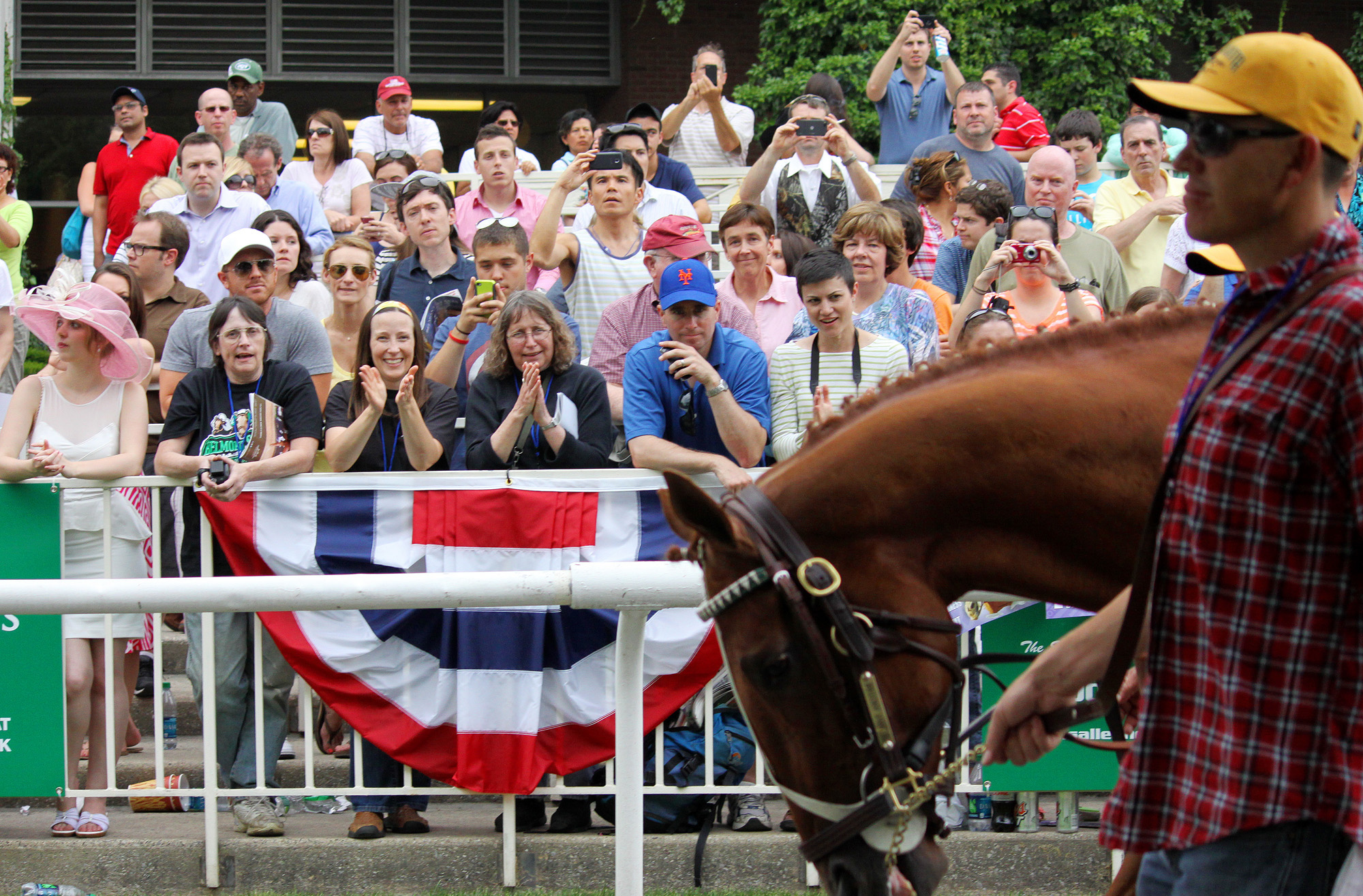
Paul Reddam, the businessman and horse owner, doesn’t adhere to the “one race at a time” policy that guides many horse people. Even as I’ll Have Another readied for his date with destiny in the Belmont Stakes, having landed two-thirds of the Triple Crown, Reddam was perusing the calendar. He thought through summer, pondered fall, and even let his mind wander into 2013.
“What I had in my head was, the horse would run in the Belmont, and he’d run one or two races before the Breeders’ Cup Classic,” Reddam said. “The next target would have been the Dubai World Cup.”
So much for big dreams. Thanks to an injured tendon, the only post-Triple Crown plans being made for I’ll Have Another concerned stud duty. And the early exit of 2012’s leading 3-year-old is fittingly, unfortunately representative of the entire class. This is the time of year when the best 3-year-olds are supposed to be moving into stakes races against older horses, wending their way toward the Breeders’ Cup, just like Reddam had planned. But before the best horses of this crop could match up against their elders, they dropped like flies.
Twenty-nine horses either won a graded stakes prep for the Triple Crown or finished in the top four in one of the Triple Crown races. By Sept. 20, only seven of those horses were in a racing pattern, though four others posted workouts in September and could start soon (see chart on page 9). Research into a decade’s worth of Triple Crown hopefuls and competitors shows that this crop actually has not lost a radically high number of horses before autumn. But the fact that nearly all the class’s most talented horses have fallen has invigorated discussion about the sturdiness of the modern Thoroughbred and the toll caused by the Triple Crown season.
In January, February, and March, Todd Pletcher held great cards. He had Algorithms, El Padrino, and Gemologist to go along with speedier-type colts such as Thunder Moccasin. Algorithms and El Padrino are training again but have yet to work since going to the sidelines. Gemologist is back on the farm after one poor summer race.
In California, Bob Baffert was loaded in the pre-Triple Crown period. He had Drill, Castaway, and Secret Circle. Then Bodemeister emerged, followed by Paynter. None of those horses will be racing anytime soon. At least Fed Biz, who got hurt in February before he could start in a stakes race, has returned to action and is going well.
“I’m down to Fed Biz,” Baffert said of his 3-year-old class. “He’s the last of the Mohicans.”
Union Rags finally displayed his ballyhooed talent winning the Belmont over Paynter. He promptly suffered a tendon injury and was retired.
“It’s certainly a difficult task going through the Triple Crown,” said Michael Matz, Union Rags’s trainer. “Especially this year.”
Two-year-old champion Hansen made it until August before he, too, was hurt and taken off the track for good.
Alpha, who in the summer won the Jim Dandy and Travers, is the most accomplished member of the class left standing. His biggest early-season triumph came in the Grade 3 Withers, and he finished 12th in the Kentucky Derby. Alpha finished sixth in last weekend’s Pennsylvania Derby, but he at least has made it into the fall.
“I just think it was fairly fluky this year,” Reddam said. “The reality is with today’s modern racehorse, for whatever reason – and I wouldn’t profess to understand it – they get injuries. Regular injuries. The chance of a horse going uninterrupted from December to May without going on the shelf is very low.”
Though not by an extreme amount, the rate of 3-year-old attrition in 2012 is on pace to be the highest in at least a decade, and the temptation is to fit the situation into what has become a common racing narrative – the demise of the Thoroughbred. Horses aren’t as tough as they used to be, this line of thinking goes. Drugs have weakened the breed. But it’s hard to pin the 2012 burnout rate on any one factor, and statistics from the last decade don’t even strongly support the idea that this is anything more than an especially unfortunate year.
“For whatever reason, there’s been a higher attrition rate this year,” Pletcher said. “Algorithms and El Padrino are starting back. You get those two going again, and suddenly, everyone will be saying what a patient trainer I am.”
Indeed, more than half of the top 3-year-olds from the first half of 2011 were able to race in the fall, and seven 3-year-olds started in Breeders’ Cup races. In 2008, 20 of 28 prep winners and top Classic finishers raced after Sept. 1. The 2007 3-year-olds had a higher rate of attrition through the season, but that was the year the crop’s leading trio – Curlin, Hard Spun, and Street Sense – raced in the Breeders’ Cup Classic, along with lesser light Tiago. By contrast, 2004 came up barren. Only 11 3-year-olds raced into the fall that year, and not one made it to the Breeders’ Cup.
“I don’t think there’s an absolute answer to any of that,” said owner Ahmed Zayat, who saw two of his horses, Bodemeister and Paynter, finish second in all three Triple Crown races. “All I know is horses are athletes. They have their day on or their day off. You never know if the next day they’ll have an injury. It’s totally random.”
DRF WEEKEND: Q&A with Zenyatta sculptress Nina Kaiser | Handicapping roundups
Zayat’s had great fortune getting horses to the Triple Crown, but none of his best 3-year-olds stuck around. Nehro didn’t race in 2011 after the Belmont Stakes. In 2010, Eskendereya was injured before the Derby, where he would’ve been favored. Pioneerof the Nile was retired after the 2009 Preakness. Still, Zayat said the Triple Crown isn’t the focus of his operation.
“We don’t custom-tailor our program for that at all,” he said. “We develop horses to try and race as individuals.”
Over the last 70 years, the average size of the Kentucky Derby has dramatically increased. Between 1963 and 1972, the Derby averaged 13.6 starters; in the last decade, the average field size has been 19.2, and with new also-eligible rules in place, no one expects the Derby gate to be filled with fewer than 20 runners in the foreseeable future. There’s little doubt all 20 animals are not particularly suited for the Triple Crown experience. Plus, by the time the Derby actually comes around, horses have been hard-pressed just to make the field.
“I couldn’t deny that the experience is hard on a horse,” said trainer Graham Motion, who won the 2011 Derby with Animal Kingdom and took fourth this year with Went the Day Well. Neither horse was able to race after Sept. 1. “I do think we’re much more focused on [the Triple Crown] than perhaps 10 or 15 years ago. We seem to push hard to get there. Having been through it the last two years, I think it’s more than a coincidence what we’re seeing this year.”
Hall of Famer Allen Jerkens, who has been training since 1950, said what strikes him most about the current 3-year-old scene is the demands of the prep-race schedule.
“The main thing I see is there are a lot more important races leading up to the Triple Crown than when I came around,” said Jerkens, who has run three horses in the Derby to no great effect. “The first ones they started doing any good with were the Flamingo, the Florida Derby. Some ran in the Louisiana Derby. I think they start too early with the 3-year-olds. They try to win a lot of other races besides the Triple Crown.
“The trend is now not to train too hard,” Jerkens said. “And horses just don’t seem to be as tough as they used to.”
Arthur Hancock III, the longtime Kentucky owner and breeder, agrees with Jerkens.
“I know that horses are much, much, much weaker today than they used to be,” said Hancock, 69, who has co-owned two Kentucky Derby winners, Sunday Silence and Gato Del Sol, and two more colts who finished second in the race.
Hancock lands dead center in the current hay, oats, and water movement. To him, the decline of the 3-year-old class of 2012 is tied directly to the decline of the American racehorse in general.
“Horses that run in the Triple Crown, they get Lasix from the time they’re first starting as 2-year-olds. They get Lasix, and they get their Bute before every race,” he said, referring to phenylbutazone, a race-day legal, non-steroidal anti-inflammatory drug. “The horses are trained now pretty much the same way, but you’ve got five generations that have been running on drugs. I think the drugs have weakened the breed.”
But to Carl Nafzger, trainer of Derby winners Unbridled and Street Sense, the breed does not seem less sound. The Triple Crown itself is not a career-crusher, nor the prep race schedule necessarily over-demanding. Both Nafzger’s Derby winners went on to race in the Breeders’ Cup Classic during the fall of their 3-year-old season.
“It’s not the horse, the soundness of the horse, or the prep stakes,” Nafzger said. “It’s what people do to get there. ‘We gotta go to the Derby! We gotta go to the Derby!’ Everyone wants to go to the Derby. But it’s the horse that takes you there, that it’s just natural for. My [Derby] horses went on and ran a lot of races. The biggest mistake I ever made training was with Unbridled going into the Belmont. That was the shortest horse I ever ran. I didn’t do enough with him. Listen, you see a horse of extraordinary ability you give them a chance to prove himself. If he doesn’t, fine, you drop back and reroute them.”
The young 3-year-old truly suited to the Triple Crown grind is a rare individual. Pletcher rightly points out the difficulty of keeping a horse of any age in top form through an entire year, but things get especially dicey with 3-year-olds.
“We are asking them to peak physically at a time when they’re skeletons are still developing,” said noted equine surgeon Dr. Larry Bramlage. “A horse’s cardiovascular system is so good, that can get to a point of maturity before their skeleton does. In humans it’s the heart and lungs that are the limiting factor in young athletes. People don’t have to double the size of their shins before they become really good athletes.”
From Baffert’s point of view, the pool of candidates who might be a natural fit for the Triple Crown has dwindled considerably.
“Things have really changed. A lot of our good breeding stock has gone to Japan or somewhere else. I was looking at Book 1 of the Keeneland sale,” said Baffert, referring to the most fashionable portion of Keeneland’s September yearling sale, “and the mares just aren’t around anymore. You got a lot of horses that are precocious, who have speed and carry it. You don’t see the Classic kind of horses like you used to.”
Maybe the Baffert-trained Fed Biz can emerge from relative obscurity near the end of his 3-year-old season to win the Breeders’ Cup Classic. Maybe 2012 will be seen as the year when the fragility of the young modern Thoroughbred came fully to light. And maybe, down the road a spell, the season will have faded gently into the fabric of racing history.
“Five years from now,” Pletcher said, “we might all look back and say this was just a bad year.”
Class of 2012 status report
| HORSE | WINNING PREP OR TRIPLE-CROWN PLACING (TOP FOUR ONLY) | LAST RACE | STATUS |
|---|---|---|---|
| Algorithms | Holy Bull | Holy Bull, 1st (Jan. 29) | Out since Feb. 25 with fractured splint bone; resumed training |
| All Squared Away | Lexington | Del Mar Derby, 7th (Sept. 2) | Active |
| Atigun | Belmont (3rd) | Travers, 4th (Aug. 25) | Active |
| Battle Hardened | Sam Davis | allowance, 9th (Sept. 22) | Active |
| Bodemeister | Ark. Derby, Ky. Derby (2nd), Preakness (2nd) | Preakness, 2nd (May 19) | Retired Aug. 21 with shoulder injury |
| Castaway | Southwest | Lexington, 9th (April 21) | Working |
| Creative Cause | San Felipe, Preakness (4th) | Preakness, 3rd (May 19) | Working |
| Daddy Nose Best | El Camino Real, Sunland Derby | Hall of Fame, 3rd (Aug. 10) | Active |
| Done Talking | Illinois Derby | Long Branch, 5th (July 8) | Out with various minor injuries |
| Drill | San Vicente | Laz Barrera, 1st (May 12) | Out since July ankle surgery |
| Dullahan | Blue Grass, Ky. Derby (3rd) | Pacific Classic, 1st (Aug. 26) | Active; expected to run Saturday |
| El Padrino | Risen Star | Ky. Derby, 13th (May 5) | Freshened for possible fall campaign |
| Gemologist | Wood Memorial | Haskell, 6th (July 29) | Out of training |
| Hansen | Gotham | W.V. Derby, 4th (Aug. 4) | Retired Sept. 16 with tendon injury |
| Hero of Order | Louisiana Derby | Super Derby, 6th (Sept. 8) | Active |
| Hierro | Derby Trial | Woody Stephens, 6th (June 9) | Out for undisclosed reasons |
| I'll Have Another | Lewis, SA Derby, Ky. Derby (1st), Preakness (1st) | Preakness, 1st (May 19) | Retired June 8 with tendon injury |
| Mr. Bowling | Lecomte | Louisiana Derby, 12th (April 1) | Out since April; back in light training |
| Out of Bounds | Sham | Sham, 1st (Jan. 7) | Out since March 7 cannon-bone surgery |
| Paynter | Belmont (2nd) | Haskell, 1st (July 29) | Recovering from colitis |
| Prospective | Tampa Bay Derby | Jim Dandy, 8th (July 28) | Working toward race in fall |
| Secret Circle | Southwest, Rebel | Ark. Derby, 2nd (April 14) | Out since leaving Ark. Derby with sesamoid injury |
| Street Life | Belmont (4th) | Travers, 11th (Aug. 25) | Retired Aug. 30 with ruptured ligament in pastern |
| Take Charge Indy | Florida Derby | Ky. Derby, 19th (May 5) | Surgery to remove bone chip after Ky. Derby; worked Sept. 16 |
| Thunder Moccasin | Hutcheson | Hutcheson, 1st (Feb. 11) | Last worked Aug. 6 |
| Trinniberg | Swale, Bay Shore | Gallant Bob, 2nd (Sept. 22) | Active |
| Union Rags | Fountain of Youth, Belmont (1st) | Belmont, 1st (June 9) | Retired June 16 with tendon injury |
| Went the Day Well | Spiral, Ky. Derby (4th) | Preakness, 10th (May 19) | Out for year with bone bruise in ankle found in July |
| Zetterholm | Preakness (4th) | Dwyer, 4th (June 30) | Out since injuring foot in Dwyer |
Injury rate
Attrition of 3-year-olds who won a Kentucky Derby prep race or finished in the top four of a Triple Crown race:
| YEAR | HORSES | OUT BY SEPT. 1 |
|---|---|---|
| 2012 | 29 | 18* |
| 2011 | 31 | 15 |
| 2010 | 29 | 17 |
| 2009 | 23 | 10 |
| 2008 | 28 | 8 |
| 2007 | 24 | 13 |
| 2006 | 23 | 12 |
| 2005 | 28 | 11 |
| 2004 | 28 | 17 |
| 2003 | 27 | 13 |
*Four horses have worked since Sept. 1 and could race soon.