

Belmont Stakes rematches of the past have echoed the 2011 showdown
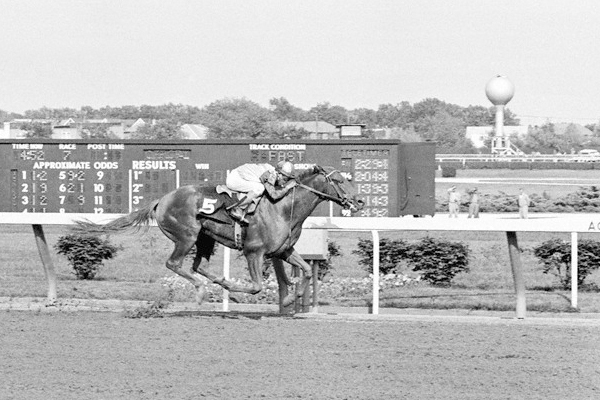
There is a rigid scale by which the level of excitement is measured when it comes to anticipation for the Belmont Stakes, and no amount of public relations can shake the equation. In descending order, the various possibilities look like this, beginning with Level 1 (also called Code Secretariat), in which a superstar romps in the Derby and Preakness and all that’s left for the Belmont is the giddy coronation:
Level 2 – Unbeaten over-achiever comes to town with chance to make history in Triple Crown (see Seattle Slew, Smarty Jones).
Level 3 – Classy, hard-pressed winner of Derby and Preakness meets a primary foe or foes once again in New York with the Crown on the line (see Sunday Silence, Silver Charm, among others).
Level 4 – Bonafide superstar who got the shaft in the Derby and bounced back in the Preakness looks to Belmont for solace (see Native Dancer, Damascus, Point Given).
Level 5 – Different winners of Derby and Preakness, having swapped tough decisions, use the Belmont to settle the score.
Level 6 – Different winners of Derby and Preakness, having thrown in bad races when they lost, try to answer questions of class.
Level 7 – Preakness winner a no-show but at least network TV has the Derby winner to play with.
Level 8 – Derby winner a no-show and no one can remember who won the Preakness until he’s identified in the post parade.
Level 9 – Both Derby and Preakness winners stay away. Yankees batting practice draws more fans.
The 143rd Belmont Stakes on Saturday comes in at a solid Level 5. Shackleford was a respectable fourth after setting the pace in the Derby, then won the Preakness. Animal Kingdom encored his Derby victory by just missing to Shackleford in Baltimore. Now they are back for the rubber match in the Belmont‘s 1 1/2 miles.
However, to call such an encounter the next chapter in a rivalry is stretching it. Before they were circling in the Churchill Downs mile chute, along with the 17 other colts getting ready to walk to the Derby paddock, Animal Kingdom had never laid eyes on Shackleford, and Shackleford couldn‘t even spell Animal Kingdom's name. The fact that they emerged from the Derby and Preakness the two best of the bunch is typical of the competitive geography these days. There are so many choices for 3-year-olds approaching the Triple Crown, chances are the best won’t meet until Louisville and beyond.
Rivalries or not, there have been any number of exciting Belmont showdowns over the past 70 years, when both the Derby winner and Preakness winners raced for bragging rights as division leader. The best of those have echoed the Animal Kingdom-Shackleford confrontation looming this weekend.
In 1942, Shut Out and Alsab ran one-two in the Derby, but on the following Saturday, Alsab was clearly best when Shut Out was fifth in the Preakness. The dust cleared, and Shut Out came back to beat runner-up Alsab by two in the Belmont.
In 1956, Needles and Fabius swapped one-twos in the Derby and Preakness, leaving it to Needles to break the tie in the Belmont, where his rival was third.
Then there was the memorable Triple Crown of 1963, during which Chateaugay beat a troubled Candy Spots in the Derby, Candy Spots had smooth sailing to beat Chateaugay in the Preakness, and Chateaugay had the last say in the Belmont, leaving Candy Spots behind in second.
That was enough to earn a championship for Chateaugay, since winning two out of the three Triple Crown races usually does the trick – unless your name was Middleground and the year was 1950.
Hill Prince and Middleground already had a pretty hot rivalry going on paper as their 3-year-old season dawned. In 1949, Hill Prince won 6 of 7 races, including the Cowdin in New York, and was top-weighted on John B. Campbell 2-year-old ratings at 126 pounds. Middleground won 4 of 5 starts, including the Hopeful, and was voted champion of the division, even though Campbell had him pegged at 124.
They got down to settling things in April of 1950 in the Wood Memorial, run at Jamaica, where Hill Prince beat Middleground by two. In the Derby, two weeks later, Middleground had all the right answers for 16-year-old apprentice Bill Boland and defeated Hill Prince by 1 1/4 lengths. One week later, both colts met in the Withers at Belmont and it was Hill Prince by 1 1/2 lengths over Middleground. Then came the Preakness, in which Hill Prince beat runner-up Middleground by five. Let Boland explain what happened.
“Hill Prince probably shouldn’t have beat him in the Preakness,” said Boland, a Hall of Famer, from his Florida home. “There was a horse who bolted going into the first turn and carried Middleground way past the middle of the track. That let Hill Prince through on the inside and he opened up four or five lengths. By the time I was able to get my horse back to the inside Hill Prince was long gone.”
But not forgotten. When they met again in the Belmont Stakes, on May 30, 1950, Max Hirsch had Middleground loaded for bear and a confident teenager in the boot.
“I’d already ridden a mile and a half there quite a few times, including a maiden race, so that was no big deal for me,” Boland said. “But I did get a little lucky that day.
“Hill Prince broke slow but I broke slower,” Boland went on. “I was following him, and he got through on half the field going into the first turn. I went from last going in and come out fourth, and I was in the catbird seat from there on. Going by Hill Prince I knew he was dead.”
Middleground beat Lights Up by a length as Hill Prince backed up to be seventh. The two rivals – and by now no one doubted they were – met once more in the Jerome Handicap at Belmont in September. Middleground had not trained well and finished 10th, while Hill Prince won by four. At year’s end Hill Prince took votes for both 3-year-old champ and Horse of the Year. Middleground, the double classic winner, fractured his ankle in a workout that fall and was retired.
“I rode High Gun once, as good as any horse I rode, and Sword Dancer when he should have won the Derby,” said Boland, who turns 77 in July. “Beau Purple could beat any man’s horse on a given day. I’d have to say Middleground was right there among them.”
Then again, what’s a man going to say about a colt who gave him a Derby and a Belmont before he turned 17? Boland was asked what he did to celebrate the fact that he was, at least on that day, the toast of New York racing.
“I had a room outside the gate at Belmont,” Boland replied. “After the Belmont I walked home, got up the next morning, and walked to work.”
SETTLING THE SCORE
In the 21 times the Kentucky Derby winner has faced the Preakness winner in the Belmont Stakes, the Preakness winner has won 10 times and the Derby winner 5.
| YEAR | KENTUCKY DERBY | PREAKNESS STAKES | BELMONT STAKES |
|---|---|---|---|
| 2005 | Giacomo 1st | Afleet Alex 1st | Afleet Alex 1st |
| Afleet Alex 3rd | Giacomo 3rd | Giacomo 7th | |
| 2001 | Monarchos 1st | Point Given 1st | Point Given 1st |
| Point Given 5th | Monarchos 6th | Monarchos 3rd | |
| 1994 | Go for Gin 1st | Tabasco Cat 1st | Tabasco Cat 1st |
| Tasbasco Cat 6th | Go for Gin 2nd | Go for Gin 2nd | |
| 1993 | Sea Hero 1st | Prairie Bayou 1st | Sea Hero 7th |
| Prairie Bayou 2nd | Sea Hero 5th | Prairie Bayou DNF | |
| 1991 | Strike the Gold 1st | Hansel 1st | Hansel 1st |
| Hansel 10th | Strike the Gold 6th | Strike the Gold 2nd | |
| 1988 | Winning Colors 1st | Risen Star 1st | Risen Star 1st |
| Risen Star 3rd | Winning Colors 3rd | Winning Colors 6th | |
| 1984 | Swale 1st | Gate Dancer 1st | Swale 1st |
| Gate Dancer 4th (DQ to 5th) | Swale 7th | Gate Dancer 6th | |
| 1982 | Gato Del Sol 1st | Aloma’s Ruler 1st | Gato Del Sol 2nd |
| Aloma’s Ruler (did not run) | Gate Del Sol (did not run) | Aloma’s Ruler 9th | |
| 1980 | Genuine Risk 1st | Codex 1st | Genuine Risk 2nd |
| Codex (did not run) | Genuine Risk 2nd | Codex 7th | |
| 1975 | Foolish Pleasure 1st | Master Derby 1st | Foolish Pleasure 2nd |
| Master Derby 4th | Foolish Pleasure 2nd | Master Derby 3rd | |
| 1974 | Cannonade 1st | Little Current 1st | Little Current 1st |
| Little Current 5th | Cannonade 3rd | Cannonade 3rd | |
| 1967 | Proud Clarion 1st | Damascus 1st | Damascus 1st |
| Damascus 3rd | Proud Clarion 3rd | Proud Clarion 4th | |
| 1963 | Chateaugay 1st | Candy Spots 1st | Chateaugay 1st |
| Candy Spots 3rd | Chateaugay 2nd | Candy Spots 2nd | |
| 1962 | Decidedly 1st | Greek Money 1st | Decidedly 4th |
| Greek Money (did not run) | Decidedly 8th | Greek Money 7th | |
| 1956 | Needles 1st | Fabius 1st | Needles 1st |
| Fabius 2nd | Needles 2nd | Fabius 3rd | |
| 1950 | Middleground 1st | Hill Prince 1st | Middleground 1st |
| Hill Prince 2nd | Middleground 2nd | Hill Prince 7th | |
| 1949 | Ponder 1st | Capot 1st | Capot 1st |
| Capot 2nd | Ponder 5th | Ponder 2nd | |
| 1942 | Shut Out 1st | Alsab 1st | Shut Out 1st |
| Alsab 2nd | Shut Out 5th | Alsab 2nd | |
| 1940 | Gallahadion 1st | Bimelech 1st | Bimelech 1st |
| Bimelech 2nd | Gallahadion 3rd | Gallahadion 5th | |
| 1877 | Baden-Baden 1st | Cloverbrook 1st | Cloverbrook 1st |
| Cloverbrook (did not run) | Baden-Baden (did not run) | Baden-Baden 3rd | |
| 1875 | Aristides 1st | Tom Ochiltree 1st | Aristides 2nd |
| Tom Ochiltree (did not run) | Aristides (did not run) | Tom Ochiltree 7th |