

Aqueduct's inner track will become turf course
New York racing’s landscape is about to undergo a significant change.
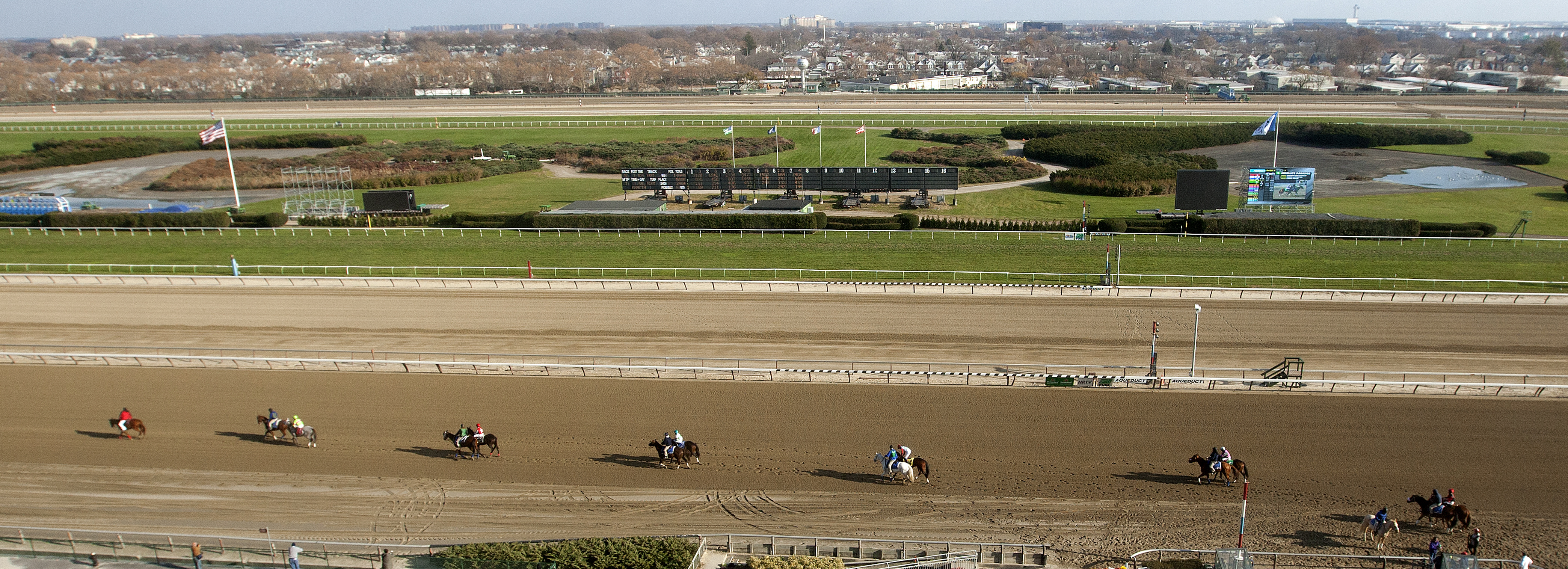
The New York Racing Association will remove the inner track at Aqueduct and replace it with a second turf course. Further, the main dirt track will be renovated to allow winter racing on it.
The project to remove the inner track began this week – shortly after the Aqueduct backstretch was closed for training for the summer – and should be completed by the time Aqueduct reopens for training in September, and certainly by the time racing returns in November.
When Aqueduct’s current incarnation opened in 1959, it had one dirt track and two turf courses. In 1975, the outer turf course was replaced by a one-mile inner dirt track. The inner track had a limestone base that enabled it to handle winter weather better than the main track, which had a clay/silt/sand base.
The main track will have a limestone base and a sandy loam cushion, according to Glen Kozak, NYRA’s director of racing surfaces.
“All we’re doing is putting in a limestone base, similar to what the winter track had or what the [Belmont] training track has,” Kozak said. “The only thing that we’ll be doing to the cushion is add clay to hold moisture and tighten the track up.”
Though Aqueduct conducts turf racing for only about eight weeks a year, NYRA officials believe a second turf course will enable it to offer additional grass races, which typically fill better than dirt races.
Moreover, by moving all dirt racing to the main track, it will allow flexibility for the racing office to write races at multiple distances in the winter.
“We struggle mightily with field size during the wintertime,” said Martin Panza, senior director of racing operations for NYRA. “I think by being able to use our outer track and varying our distances, it’s probably going to help with field size.”
On the inner track, sprint races could be carded up to only six furlongs. On the outer track, one-turn races up to one mile can be run.
Another potential benefit of adding a second turf course at Aqueduct would be to conduct racing there for an extended period of time should there be a renovation of some sort at Belmont Park that would require it to close temporarily.
Kozak said the new turf course will be one mile in circumference, as was the inner track. The current turf course is seven furlongs.
There will be a new sprinkler system installed for both turf courses as well as a better irrigation system to help with drainage.
Field size for turf races is significantly larger than for dirt races. At the recently concluded spring meet, field size for the 30 turf races run was 7.50 horses per race, compared to 6.64 horses per dirt race. For the five spring meets prior to this year, average field size for the turf was at least one horse higher than for the dirt.
At four of the last six Aqueduct fall meets, average field size for the turf was more than two horses higher than for the dirt.
Obviously, turf racing is weather-dependent. At the 2015 Aqueduct fall meet, NYRA conducted 73 turf races. The previous fall, it ran only 42.
“It’s going to help us from a turf standpoint,” Panza said. “We’re going to be able to write some turf sprints and obviously a few more turf races, especially coming out of Belmont fall.”
