2017 Kentucky Derby TimeformUS pace projector
How does the Projector work? The TimeformUS Pace Projector attempts to predict how a race will unfold early. It displays the horses ranked by the TimeformUS Early Speed Rating – fastest in the front, slowest in the rear. The image shows where the horses are projected to be after the first half-mile of a route race. The front is displayed to the right. It also attempts to determine if the pace of the race is likely to be fast, average, or slow.
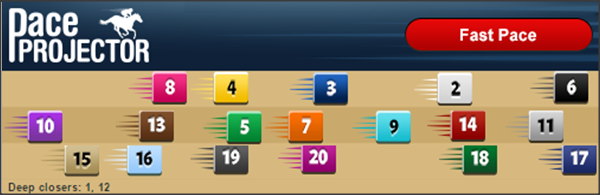
What is the Pace Projector saying about the Kentucky Derby? This race is likely to have a fast pace, according to the Pace Projector. This “fast pace” designation is based on the number of horses with a preference for racing on or near the lead and how closely those horses are rated on the aforementioned Early Speed Rating. Of the 20 horses drawn into the main field, 10 have been designated with TimeformUS running styles of Leader, Speed, or Tracker. Three of these 10 are shown grouped together near the front – State of Honor (#6), Battle of Midway (#11), and Irish War Cry (#17).
Are there any quirks to this particular distance, surface, or field size that the algorithm adjusts for? The large field size is taken into account by the Pace Projector when assessing if the pace is likely to be fast, average, or slow. It is definitely part of the reason the “Fast Pace” designation is displayed. At this distance and longer, the “Favors Horses On/Near Early Lead” is not an available option, though it obviously wouldn’t be shown for this particular race in any case. It does take more speed horses to display the “Fast Pace” label on dirt than it does on turf or synthetic surfaces since the pace for dirt races is generally faster than those on other surfaces.
Based on a more nuanced, granular look at the past performances, from watching the races, knowing the jockeys and trainers tendencies, etc., which horses do you think are likely to show more or less early speed than in this Projector? Always Dreaming (#5), the co-second choice on the morning line at 5-1, is an interesting case. He is shown well back in 11th position early, despite having the TimeformUS running style of Leader. A look at his past performances helps explain this:
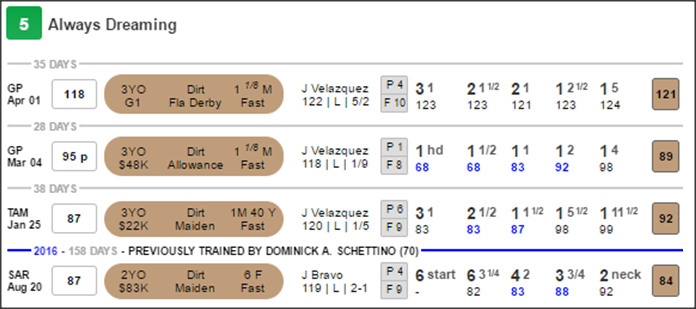
In his maiden try in August, he had some trouble at the start and got caught behind a slow pace. The pace figures shown above are for the leader of the race at that point. In the next two races, Always Dreaming was completely dominant and didn’t have to run much at all early to beat those fields. Once again, the pace figures are in blue. Last out when winning the Florida Derby, he was able to step up his level to beat much better competition and ran much faster early. He is clearly capable of laying closer than he is shown in the Pace Projector. The Early Pace Rating that is a key piece of the Pace Projector looks at multiple races and is cumulative, but in this case the last race probably should be given more weight. Handicappers are encouraged to add their own inputs to this tool. This is a case where that is probably a very good idea.
Does any horse stand out as exceptional on TimeformUS Late Pace Figures, if the pace turns out to be hot? Two horses are tied for the best Late Pace Rating with 117 – Lookin At Lee (#1) and Gunnevera (#10). Of these two, Gunnevera has run the best overall races. He has better TimeformUS Speed Figures and also has been able to getting into races sooner. It is best to be wary of horses like Lookin At Lee that are assigned a running style of Plodder by TimeformUS.
How have recent editions of the Kentucky Derby developed from a pace standpoint? This will be the fifth Kentucky Derby since the points system was implemented to determine the field. The race has featured a fast pace in two of the previous four, and none have been designated as slow. There is virtually no chance for a slow pace in a race with a field this big. The last three winners sat second or third after the opening half-mile, but Orb did manage to win from well back in 2013 when the pace was very fast, a 165 TimeformUS Pace Figure for the opening half-mile. The betting favorite has won every Derby since the points system was implemented.